


The essential takeaway: Modern start-stop systems utilize precision sensors and reinforced components like AGM batteries to reduce fuel consumption by up to 12%. This technology optimizes efficiency during idling while prioritizing engine longevity through rigorous thermal and electrical monitoring. Notably, these heavy-duty starters are engineered to endure 250,000 cycles, far exceeding the 30,000-cycle threshold of conventional vehicles.
The start stop system is now a standard integration in modern vehicles to optimize fuel efficiency and meet stringent Euro 6 emission standards. Our technical analysis provides a detailed perspective on how the Electronic Control Unit coordinates reinforced starters and AGM battery technology to maintain performance. You will discover the operational logic behind these high-cycle components and professional solutions for managing system availability.
- Mechanics of the Modern Start-Stop System
- Heavy-Duty Components for High-Cycle Use
- Factors Influencing System Availability and Efficiency
- Troubleshooting Frequent System Faults and Inactivity
- Managing the Auto Start-Stop Functionality
Mechanics of the Modern Start-Stop System
While the engine cutting out at a red light feels strange, it's actually a precision-engineered dance of sensors and logic. This technology, often called a micro-hybrid system, serves to mitigate fuel consumption and carbon emissions during idle periods.
Operational Logic and Sensor Integration
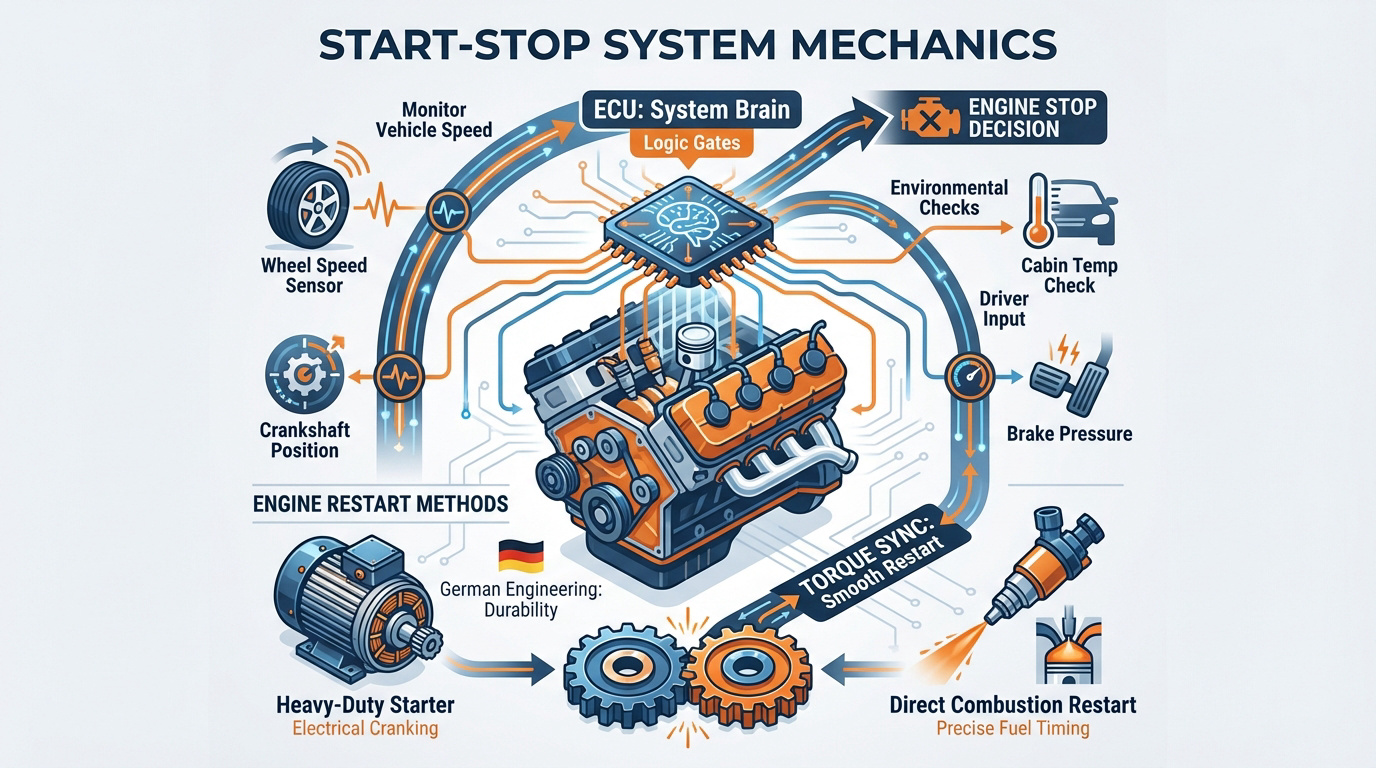
The ECU monitors wheel speed and crankshaft position. It identifies exact piston alignment for a quick fire-up. The start stop system won't activate if you are creeping forward. Precision is mandatory here.
Environmental checks are performed simultaneously. The system analyzes cabin temperature and brake vacuum pressure. If the AC is working too hard, the engine stays on. Comfort remains a priority.
Triggers differ by transmission type. For manuals, it requires neutral and clutch out. For automatics, a firm press on the brake pedal suffices. The logic adapts to your driving style.
The Electronic Control Unit acts as the brain. It balances fuel savings against driver comfort and safety. It processes data from multiple sources instantly.
Success relies heavily on sensor accuracy. One bad reading from the brake pressure sensor disables everything. Reliability is built into every calculation.
Engine Restart Methods: Starter vs. Combustion
Heavy-duty starter motors compete with direct-start methods. Some systems utilize the alternator as a motor. Others inject fuel into a cylinder already in the power stroke. Both methods aim for efficiency.
Timing differences define the experience. Electrical cranking is reliable but slightly slower. Combustion-based restarts are nearly instantaneous and much quieter. This reduces the perceived delay for the driver.
Torque synchronization is a technical requirement. The engine must match the transmission speed perfectly. This prevents that annoying jerk when lifting your foot. Smoothness is the ultimate goal.
The role of fuel injection timing is paramount. It must be precise down to the millisecond. This ensures the engine fires up without hesitation.
Modern German engineering often favors reinforced starters. These units provide sheer durability in dense urban traffic. They are built for hundreds of thousands of cycles.
For those who find the constant cycling intrusive, we offer specialized auto stop and start eliminator kits on our store. These kits allow you to regain control over your vehicle's behavior without permanent modifications.
Heavy-Duty Components for High-Cycle Use
Since these engines stop and start thousands of times more than older cars, the internal hardware had to evolve significantly to maintain long-term reliability and performance.
Advanced AGM and EFB Battery Technology
AGM (Absorbent Glass Mat) batteries utilize specialized fiberglass mats to hold the electrolyte. This unique chemistry allows for significantly faster charging rates and much deeper discharges than fluid-based designs.
Contrast this with EFB (Enhanced Flooded Batteries), which represent a sophisticated middle ground. They offer better durability than standard lead-acid units but remain more cost-effective than full AGM technology.
The Battery Management System (BMS) acts as the brain, constantly monitoring the state-of-charge. If the battery voltage drops too low, the system intelligently prevents the start-stop function from engaging.
Standard batteries will fail quickly in these vehicles. They simply aren't engineered to handle the constant high-amperage draws required for frequent engine restarts.
In fact, battery health is the number one reason for system failure. Maintaining a robust power source is vital for consistent operation.
Reinforced Starters and Specialized Bearings
Starter motors in these vehicles feature significant upgrades, including stronger brushes and robust gears. These units are specifically designed to handle over 250,000 cycles, far exceeding the 30,000-cycle limit of traditional starters.
Engineers also integrated polymer-coated bearings to combat oil pressure drops during stops. These special coatings effectively prevent metal-on-metal contact during the critical split second of the engine restarting.
Durability testing for these components is notoriously rigorous. Manufacturers simulate years of intense urban driving within just a few weeks to ensure every part meets strict performance standards.
We use hardened steel for the ring gear. This prevents premature wear from frequent engagement.
Reliability is key. These performance components are built to last.
If the frequent cycling remains a source of frustration, we offer auto stop and start eliminator kits on our store to provide you with permanent control over your vehicle's behavior.
Factors Influencing System Availability and Efficiency
You might notice the system doesn't always work, but that’s usually by design rather than a fault.
Environmental Impact and Engine Temperature
The engine requires a specific operating temperature. This warm-up phase ensures optimal oil flow. Only then does the ECU allow the motor to shut down.
Extreme cold reduces battery chemical efficiency. Freezing weather often disables the system. The vehicle prioritizes engine cranking power for the driver’s safety.
Protection protocols monitor high heat levels. The cooling fan must remain operational. The engine stays on to keep vital coolant circulating throughout.
Winter driving is tough. Expect the auto-stop feature to be inactive often.
It's all about engine longevity. The ECU prioritizes protection over fuel.
Electrical Load and Battery State-of-Charge
High-draw accessories impact system availability. Seat heaters and defrosters consume significant power. If the electrical load is too high, idling continues.
The BMS monitors a voltage threshold. It requires a minimum state-of-charge, typically 70-80%. Low levels trigger a "system unavailable" notification immediately.
Regenerative braking supports the battery. The alternator captures energy during deceleration phases. This helps top up the charge for the next stop.
Heavy traffic drains power. Your infotainment system might be the reason for idling.
Efficiency is a balance. Powering the cabin electronics is the priority.
If the constant cycling of the start stop system becomes a nuisance during your daily commute, we offer specialized auto stop and start eliminator kits on our store to give you full control over your vehicle's behavior.
Troubleshooting Frequent System Faults and Inactivity
When that little "A" with a slash through it appears on your dash, it's time to play detective.
Understanding System Unavailable Messages
Various triggers cause dashboard warnings. Often, specific operational conditions remain unmet. This does not necessitate a mechanic visit immediately. We recommend checking your vehicle settings first.
Short trips create significant issues. Driving only two miles prevents the alternator from recharging the battery. Consequently, the system deactivates to preserve essential electrical energy.
Sensor calibration plays a role. A loose hood latch or door sensor interferes with logic. The car assumes a door is open and disables the auto-start function for safety.
Avoid immediate panic. Most system faults represent temporary software logic hurdles.
Verify your battery voltage. It remains the most frequent culprit for these errors.
Impact of Driving Habits on Battery Health
Urban traffic demands constant cycles. This frequency puts immense stress on EFB units. These batteries degrade rapidly without occasional long-distance highway runs to recover.
Follow strict maintenance routines. Use a smart charger monthly for city-only vehicles. Removing sulfation from the internal plates significantly extends the component's service life.
Precise battery registration is mandatory. In German vehicles, you must inform the ECU of a new installation. Failure to do so leads to overcharging the new cell.
| Symptom | Likely Cause | Recommended Action |
|---|---|---|
| System won't activate | Low battery charge | Drive longer distances |
| Error message on dash | Sensor or logic fault | Perform OBD diagnostic |
| Slow restart | Worn starter or battery | Inspect hardware health |
| Battery light on | Charging system failure | Test alternator output |
Consistent maintenance routines prevent waste. Replacing an expensive AGM battery prematurely is a costly technical oversight.
If the constant cycling irritates you, explore our auto stop and start eliminator kits on our store. These professional solutions allow you to regain control over your engine's behavior permanently.
Managing the Auto Start-Stop Functionality
Even with all its benefits, some drivers find the hesitation at green lights more annoying than the fuel savings are worth.
Legal and Technical Aspects of Disabling the System
Many drivers seek to bypass the system to avoid frustration. They often dislike the noticeable vibrations or the slight restart delay during heavy traffic. Concerns also exist regarding long-term wear on the starter motor or turbocharger components.
Standard deactivation involves a temporary dashboard button. You must press this every single time you start the car. Alternatively, permanent software coding exists, but it carries the risk of voiding manufacturer warranties.
Modern engines feature reinforced components to handle these cycles. Despite this, enthusiast drivers frequently prefer the immediate power delivery of a constantly running engine. They value responsiveness over the automated shutdown process.
Disabling the system impacts official fuel economy ratings. Because it alters the vehicle's emissions profile, permanent modification remains a technical grey area in many jurisdictions.
Ultimately, it is a matter of personal preference. Some owners simply want their engine to stay active throughout the entire journey.
Professional Solutions for Permanent Deactivation
We offer eliminator kits as a sophisticated hardware solution. These modules remember your last chosen setting automatically. If you toggle the function off, it remains off during your next driving session.
Installation is straightforward and non-invasive. Most units are "plug and play" designs that fit discreetly behind the factory button. This avoids the need for risky hacking of the vehicle's primary software.
Our store specializes in auto stop and start eliminator kits for various models. These are ideal for drivers demanding total control over their machine’s behavior.
These hardware modules are fully reversible. If you decide to sell your vehicle, you can simply unplug the device. The car returns to its original factory configuration instantly.
Consult our online catalog to verify compatibility for your specific model. We help you reclaim your driving experience without the daily hassle of manual deactivation.
Modern start stop system technology effectively balances fuel efficiency with engine longevity through reinforced components like AGM batteries and precision ECU logic. Optimize your vehicle's performance now by ensuring peak battery health or installing a professional deactivation module. Master your driving experience with total control and reliability.
FAQ
How exactly does the modern start-stop system function?
The start-stop system, also known as "idling stop" or "micro hybrid" technology, is a sophisticated electronic orchestration designed to reduce fuel consumption and CO2 emissions. Managed by the Electronic Control Unit (ECU), the system automatically cuts the engine when the vehicle is stationary—such as at red lights or in heavy traffic—and restarts it instantaneously when the driver is ready to move. This process relies on a complex network of sensors monitoring wheel speed, battery state-of-charge, and engine temperature to ensure seamless operation.
For vehicles equipped with a manual transmission, the engine typically shuts down when the gear lever is in neutral and the clutch is released; it restarts the moment the clutch is depressed. In automatic models, the system activates based on brake pedal pressure and engine load. By eliminating unnecessary idling, especially in urban environments, users can expect fuel economy improvements ranging from 3% to 12% depending on driving conditions.
Is the frequent restarting harmful to my engine or starter motor?
It is a common misconception that start-stop cycles cause premature failure. Modern vehicles are engineered with heavy-duty components. Traditional starters are replaced with reinforced starter motors or advanced alternator-starters capable of enduring hundreds of thousands of cycles. Furthermore, internal engine components, such as crankshaft bearings, are often coated with specialized polymers to maintain lubrication and prevent wear during frequent restarts.
To further protect the hardware, the ECU implements strict safety protocols. The system will not engage if the engine has not reached an optimal operating temperature, ensuring that the oil is flowing correctly and the catalytic converter is efficient. This "intelligent" management prioritizes engine longevity over immediate fuel savings, particularly during cold starts where wear is most likely to occur.
Why does my auto start-stop feature occasionally stop working?
If you notice the "system unavailable" symbol on your dashboard, it is usually a protective measure rather than a mechanical fault. The Battery Management System (BMS) constantly monitors the state-of-charge; if the battery level drops below a specific threshold (often 70-80%), the system disables the auto-stop function to prioritize cranking power. High electrical loads from accessories like air conditioning, seat heaters, or defrosting units can also keep the engine running to maintain power stability.
Environmental factors play a significant role as well. In extreme cold, battery chemical efficiency decreases, leading the ECU to keep the engine idling. Additionally, if the vehicle is used primarily for short trips, the alternator may not have sufficient time to replenish the energy consumed during restarts. Maintaining battery health is the most critical factor in ensuring the consistent availability of the start-stop functionality.
What are the differences between AGM and EFB batteries in these systems?
Standard lead-acid batteries are insufficient for the high-amperage demands of start-stop technology. Instead, manufacturers utilize EFB (Enhanced Flooded Batteries) or AGM (Absorbent Glass Mat) batteries. EFB units are a reinforced version of standard batteries, often found in entry-level or mid-range vehicles. They offer improved cycle life and are designed to handle the frequent charging and discharging cycles inherent to "micro hybrid" systems.
AGM batteries represent the premium solution, typically reserved for high-performance or luxury vehicles with higher electrical demands. They feature fiberglass mats that absorb the electrolyte, allowing for faster charge acceptance and superior durability under deep discharge conditions. When replacing these units, it is vital to install the correct type and perform battery registration within the ECU to ensure the charging profile is optimized for the new cell.
Is it possible to permanently disable the start-stop function?
While most vehicles include a physical button to temporarily deactivate the system, it typically resets every time the ignition is turned off. For drivers who find the vibration or slight delay at green lights undesirable, professional eliminator kits offer a permanent solution. These hardware modules are "plug and play" devices that remember your last setting, allowing the system to remain off until you manually choose to reactivate it.
Our store provides specialized auto stop and start eliminator kits designed for various performance models. These solutions are fully reversible, making them an ideal choice for enthusiasts who prefer total control over their driving experience without permanently altering the vehicle's software or voiding warranties. You may browse our online catalog to find a compatible module for your specific vehicle make and model.