




Facing a persistent BMW TPMS malfunction alert often leaves drivers unsure whether the issue lies with a simple flat tire or an internal system error.
The essential takeaway: A BMW TPM malfunction that persists after manual checks often indicates failing wheel sensor batteries, which typically expire after five to ten years. Identifying this hardware issue avoids futile reset attempts. A permanent fix requires specialized diagnostic tools to pinpoint the faulty unit and mandatory reprogramming of the new component.
This guide breaks down the complete diagnostic process to help identify if the problem stems from common environmental factors, a failing sensor battery, or a more serious control module defect. Readers will discover practical troubleshooting steps and a clear comparison of repair costs to resolve the warning light effectively and avoid unnecessary dealership expenses.
- Diagnosing the Initial Alert: From Simple Checks to Reset-Procedures
- When the Reset Isn't Enough: Identifying Hardware Failures
- The Fix: Costs, Coding, and Professional Help
Diagnosing the Initial Alert: From Simple Checks to Reset-Procedures
The First Steps: Tire Pressure and Temperature
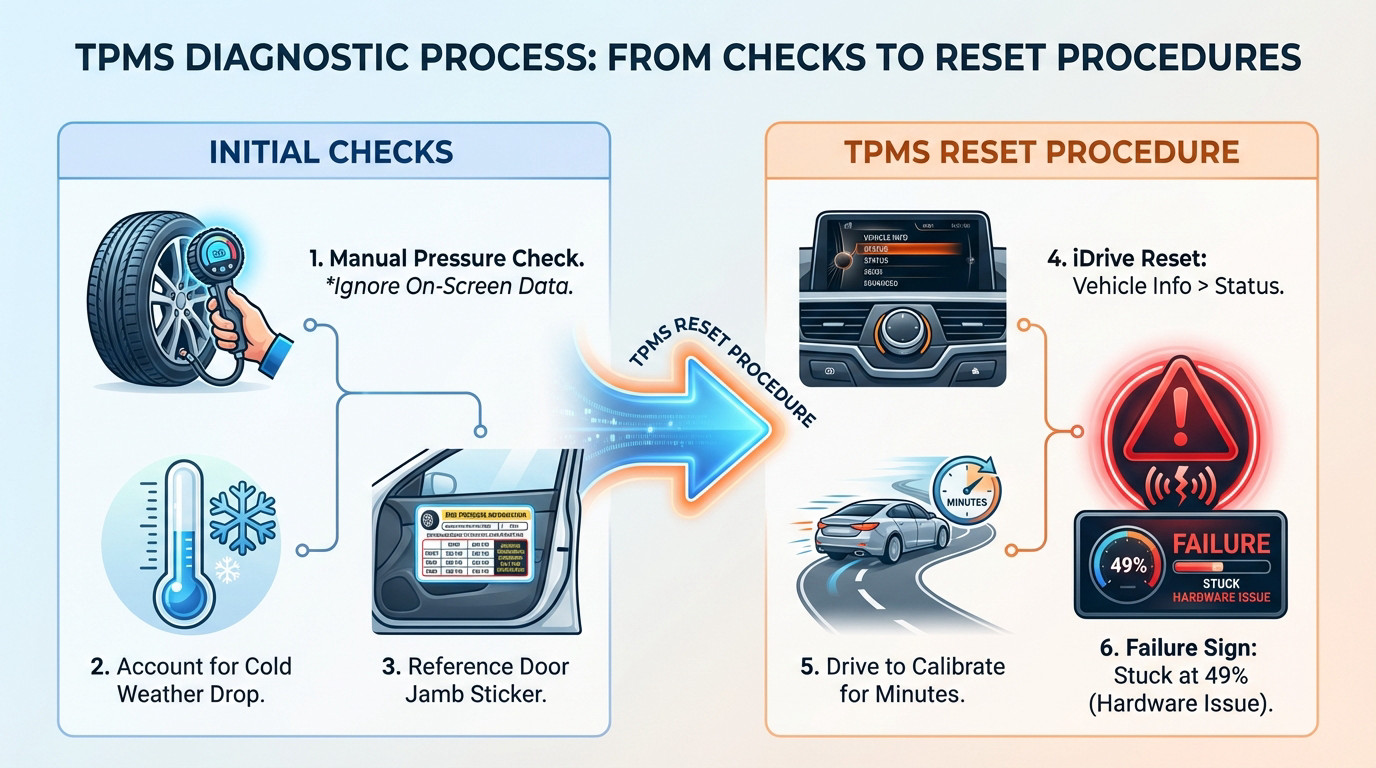
Start by manually checking all four tires with a quality gauge. Relying on on-screen readings during a bmw tpms malfunction often leads to errors, as dashboard figures cannot be trusted.
Ambient temperature significantly impacts system behavior. A sudden cold spell causes pressure to drop, triggering a temporary alert that does not indicate a real fault.
Locate the correct recommended pressures on the sticker inside the driver's door jamb. This label remains the only accurate reference for inflation.
The TPMS Reset: How and When It Fails
The typical reset process requires navigating the iDrive menus. Access 'Vehicle Info' followed by 'Vehicle Status' to initiate the standard recalibration sequence.
After starting the reset, the car must be driven for a few minutes. The system requires wheel rotation to complete the learning process.
Watch for a critical diagnostic sign. A reset that gets stuck at 49% indicates a deeper hardware or communication problem, not just low air.
- Navigate to the iDrive Vehicle Info menu.
- Select Vehicle Status.
- Choose the option to ''Reset' or 'Recalibrate'.
- Drive the vehicle for several minutes to allow the system to learn.
When the Reset Isn't Enough: Identifying Hardware Failures
So, you've checked the pressures and the reset failed. Now it's time to look at the hardware itself, where the real problems often hide.
The Usual Suspects: Failing Wheel Sensors
The most frequent culprit behind a persistent BMW TPMS malfunction is a dying sensor. These units sit inside your tire valves. They rely on a non-replaceable battery sealed within the casing. Expect a lifespan of roughly 5 to 10 years.
If your vehicle is approaching the decade mark, sensor failure is standard maintenance. It is simply not a surprise defect.
You cannot guess which specific unit is faulty by looking at it. A specialized TPMS diagnostic tool is necessary. It reads each sensor's battery status to confirm the failure.
Beyond the Sensors: The RDC Module and Fuses
If the sensors check out, the fault likely lies with the Remote Diagnostic Control (RDC) module. This component acts as the central receiver for the system. It collects every signal sent from your wheels.
When the RDC module fails, the car becomes effectively "deaf". The sensors transmit perfectly, but the system hears nothing. This is a less frequent but serious issue.
Always start with a simple preliminary check. Inspect the associated fuse, often a 5-amp fuse like #139, before assuming the expensive module is dead.
The Fix: Costs, Coding, and Professional Help
Component Replacement and Required Reprogramming
Replacing a sensor or RDC module isn't a simple swap. The new part's unique ID must be programmed into the car's computer, or the hardware remains unrecognized.
Skipping this coding renders the part invisible to the control unit. Consequently, the bmw tpms malfunction error returns immediately since the system cannot see the repair.
This oversight is a common pitfall for DIY attempts and non-specialist shops lacking the necessary software.
Breaking Down the Costs and Service Options
Costs vary significantly between dealerships, independent shops, and DIY repairs based on labor rates and part origins.
An independent BMW specialist often represents the best-value choice, possessing correct diagnostic equipment without dealership markups.
| Repair Option | Estimated Cost per Wheel | Notes |
|---|---|---|
| DIY Sensor Replacement | $75 - $125 | Requires buying the sensor and a TPMS tool for programming. Tire mounting extra. |
| Independent BMW Specialist | $150 - $250 | Includes sensor, labor, and proper programming. The most balanced option. |
| BMW Dealership | $250 - $400+ | Highest cost, but guarantees OEM parts and correct procedure. |
| System Coding (Deactivation) | $100 - $200 | One-time cost to disable the warning permanently. Legal implications apply. |
Generic auto stores sell sensors but typically cannot reprogram a new BMW sensor. You risk buying parts that leave the critical critical coding step undone.
Resolving a BMW TPMS malfunction involves a step-by-step diagnostic process. While simple pressure adjustments and system resets often suffice, persistent errors typically point to hardware failures like dead sensors. Proper identification and programming of these components remain essential for restoring the vehicle's monitoring capabilities and ensuring road safety.
FAQ
Why does the BMW iDrive display a "TPM Malfunction" warning?
This alert typically points to one of three primary issues. Frequently, a sudden drop in ambient temperature causes tire pressure to decrease, triggering a valid but temporary warning. If pressures are correct, the issue often stems from a depleted battery within one of the wheel sensors, which have a lifespan of approximately 5 to 10 years. Less commonly, the central RDC module or its fuse may have failed, preventing the system from receiving data.
How is a TPMS malfunction typically resolved?
The resolution process begins with a manual check of all tire pressures using a gauge, followed by a system reset via the iDrive "Vehicle Status" menu. The vehicle must then be driven for several minutes to allow the system to recalibrate. If the reset gets stuck—often at 49%—or fails to complete, this indicates a hardware failure requiring a specific diagnostic tool to identify the non-functioning sensor or module.
Is it safe to drive a BMW with an active TPMS malfunction warning?
Driving the vehicle is permissible provided that the driver manually verifies the pressure of all four tires with a reliable gauge. The on-screen readings should not be trusted while the malfunction error is active. However, operating the vehicle without a functional monitoring system eliminates an important safety feature, so repairs should be scheduled promptly.
Is it possible to repair the TPMS system without professional assistance?
A DIY repair is feasible but requires specific equipment beyond standard mechanics' tools. While physically replacing a sensor is straightforward, the new component must be programmed into the car's computer using a specialized TPMS diagnostic tool. Without this coding step, the vehicle will not recognize the new sensor, and the error message will persist.
Can auto parts stores like AutoZone perform a BMW TPMS reset?
Generic auto parts retailers can typically sell replacement sensors and check for basic error codes, but they generally lack the capability to complete the repair. Most do not possess the specific equipment required to reprogram a BMW's ECU to accept a new sensor ID. Consequently, a visit to a specialist or dealership is usually necessary to finalize the installation.
Is it necessary to replace all sensors if only one fails?
Replacing a single sensor is possible, but replacing all four is often recommended for vehicles nearing the 10-year mark. Since the non-replaceable batteries in these sensors have similar lifespans, the failure of one unit usually signals that the remaining sensors are nearing the end of their service life.
What are the estimated costs to repair a BMW TPMS malfunction?
Repair costs vary depending on the chosen method. A DIY replacement for a single sensor typically costs between $75 and $125, excluding the cost of a coding tool. Independent BMW specialists generally charge between $150 and $250 per wheel, which includes the part, labor, and programming. Dealership services are the most costly option, often ranging from $250 to over $400 per sensor.