

Complete Guide to Mercedes NTG and Audio 20 Systems
Mercedes NTG systems (New Telematics Generation) represent the different generations of infotainment platforms developed by Mercedes-Benz. Each generation introduced major improvements in interface design, navigation technology, connectivity, and processing power.
Alongside the COMAND NTG systems, Mercedes also offered simpler multimedia units called Audio 20, typically without built-in navigation. These systems often use the same NTG architecture but with fewer features.
Understanding the differences between Mercedes NTG and Audio 20 is essential when identifying your vehicle’s system and choosing compatible upgrades such as CarPlay or Android Auto modules.
Add Wireless Apple CarPlay to Your NTG System
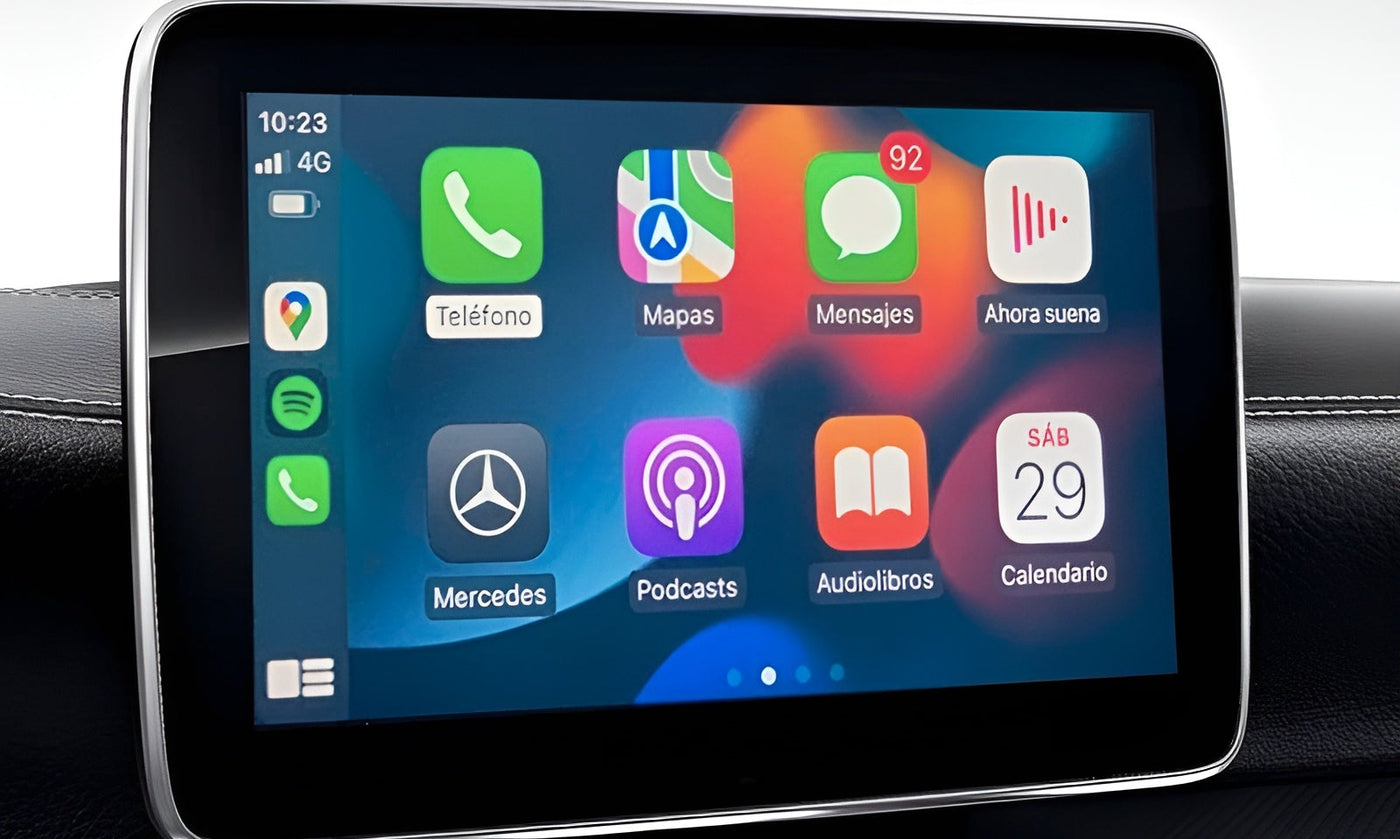
If your Mercedes only supports wired smartphone connectivity — or does not support Apple CarPlay or Android Auto at all — the system can be upgraded with a wireless solution.
You can visit our online store to discover our Wireless CarPlay kits for Mercedes, designed to work directly with the original NTG system.

These retrofit modules add wireless Apple CarPlay and Android Auto while keeping the original Mercedes interface and factory controls. Installation is typically plug-and-play, and all original functions remain fully operational.
NTG 1 (2002 – 2008)

NTG 1 was the first modern COMAND system. For its time it was an advanced system combining GPS navigation, radio, and telephone functions.
Navigation operated using DVD discs, which had to remain inserted in the drive. The interface relied on simple menus controlled by a rotary knob and physical buttons.
This generation marked the transition from separate electronic modules to a more centralized multimedia system, although processing speed remained limited. Bluetooth support was usually restricted to phone calls only.
Typical vehicles equipped with NTG 1 include:
-
E-Class W211 (2002–2008)
-
CLS C219 (2004–2010)
-
SL R230 facelift
NTG 2 (2004 – 2011)

NTG 2 was designed mainly for compact and mid-range vehicles. Unlike NTG 1, the screen and head unit were integrated into a single device in the dashboard.
The system offered improved ergonomics and more modern menus, but navigation still relied on DVDs. Overall performance was slightly better than NTG 1, though still relatively slow by modern standards.
Common models equipped with NTG 2 include:
-
A-Class W169
-
B-Class W245
-
CLK W209
-
Late C-Class W203
NTG 2.5 (2008 – 2012)

NTG 2.5 was a major improvement over NTG 2 and introduced modern multimedia features.
This generation added an internal hard drive for navigation and media storage, making the system significantly faster and more responsive. It also introduced SD card support and improved Bluetooth connectivity.
Vehicles equipped with NTG 2.5 include:
-
A-Class W169 facelift
-
B-Class W245 facelift
-
Viano W639
-
Sprinter W906
NTG 3 (2005 – 2009)

NTG 3 was designed for higher-end Mercedes models and introduced the COMAND system with a large standalone display mounted on the dashboard.
The system featured a more advanced interface and modular architecture than NTG 1 or NTG 2. However, navigation still relied on DVD discs and system speed remained moderate.
Models equipped with NTG 3 include:
-
Early S-Class W221
-
Early CL C216
-
Early GL X164
NTG 3.5 (2009 – 2014)

NTG 3.5 represented a major technological upgrade and is often considered the first truly modern Mercedes infotainment system.
This generation introduced hard-drive-based navigation, faster processing, and improved graphics. It also added SD card support and Bluetooth audio streaming.
Compared to NTG 3, the interface was smoother and navigation performance improved significantly.
Models equipped with NTG 3.5 include:
-
S-Class W221 facelift
-
CL C216 facelift
-
GL X164 facelift
-
SL R230 facelift
NTG 4.0 (2008 – 2011)

NTG 4 introduced a new electronic architecture and was installed in many popular Mercedes models.
This generation brought noticeable improvements in processing power and multimedia features. Bluetooth audio streaming and USB connectivity became common, and displays became larger and easier to read.
Typical vehicles include:
-
C-Class W204 phase 1
-
E-Class W212 phase 1
-
GLK X204 phase 1
NTG 4.5 (2011 – 2015)

NTG 4.5 marked an important step toward connected services and online functionality.
Navigation became faster and graphics improved significantly. Internet-based features were introduced, and the controller design became more ergonomic.
Models equipped with NTG 4.5 include:
-
C-Class W204 facelift
-
E-Class W212 facelift
-
CLS W218
-
ML W166
-
GL X166
NTG 4.7 (2013 – 2016)

NTG 4.7 is an optimized version of NTG 4.5 with improved performance and reliability.
Startup times are shorter, the system is more stable, and the interface is slightly refined.
Models equipped with NTG 4.7 include:
-
Early S-Class W222
-
Early C-Class W205
-
GLA X156
NTG 5.x (2014 – 2018)

NTG 5 introduced a completely redesigned interface and marked a major step forward in usability.
High-resolution displays and touch-based controls became common. Smartphone integration appeared during this generation, with some versions supporting Apple CarPlay and Android Auto.
Main variants include NTG 5.0, 5.1, 5.2 and 5.5.
Vehicles equipped with NTG 5 systems include:
-
C-Class W205
-
Early E-Class W213
-
S-Class W222
-
GLC X253
NTG 6 (MBUX) (2018 – 2026)

NTG 6 corresponds to the MBUX generation and represents a fully digital platform.
This system introduced advanced voice control, dual-screen displays, and a fully touch-based interface. Permanent internet connectivity and cloud-based services became standard features.
Models equipped with NTG 6 include:
-
A-Class W177
-
C-Class W206
-
E-Class W214
-
GLA H247
Mercedes Audio 20 Systems
Audio 20 systems are simplified versions of NTG-based multimedia systems.
They usually share the same hardware platform but offer fewer features and typically do not include built-in navigation. Navigation can sometimes be added using external modules.
Audio 20 NTG 4

Audio 20 NTG 4 systems provide basic multimedia functions such as radio, Bluetooth phone connectivity, and USB media playback.
Navigation is not included as standard.
Typical models include entry-level versions of:
-
C-Class W204
-
E-Class W212
Audio 20 NTG 5

Audio 20 NTG 5 systems feature larger displays and improved Bluetooth functions. Some versions support smartphone integration, including Apple CarPlay.
Typical models include:
-
C-Class W205
-
GLA X156
-
CLA C117
COMAND vs Audio 20
COMAND systems represent the high-end version of Mercedes infotainment, while Audio 20 systems are the basic alternative.
COMAND systems usually include built-in navigation, internal storage, larger displays, and more advanced functions.
Audio 20 systems typically focus on essential features such as radio and Bluetooth with fewer multimedia capabilities.
How to Identify Your Mercedes System
Correctly identifying your Mercedes infotainment system is important before purchasing upgrades or accessories.
The easiest way to determine your system is by checking the vehicle year, screen size, presence of navigation, and whether the car has a touchpad controller.
Proper identification is essential when installing CarPlay modules, updating navigation maps, or buying compatible hardware.
Accessing the Engineering Mode On NTG 5 And Others
On many infotainment systems from Mercedes-Benz, the hidden engineering menu can be accessed using a specific button combination on the head unit. This diagnostic menu provides technical information about the system, including hardware version, software details, and system configuration.
To open the engineering mode, press and hold End Call + # + 1 at the same time for a few seconds. If the procedure is successful, the engineering menu will appear on the screen.
This menu is primarily intended for diagnostics and identification purposes. It can be useful for determining your NTG version or checking system information before installing upgrades such as a CarPlay module. Changes inside the engineering menu should be made carefully, as incorrect settings may affect system operation.
Conclusion
Mercedes NTG and Audio 20 systems have evolved significantly over time.
From the early NTG 1 units to modern MBUX platforms, Mercedes infotainment systems have progressed from basic navigation devices to fully connected digital environments.
Correctly identifying your system helps avoid compatibility issues and ensures you choose the right upgrades for your vehicle.