




The essential to remember: the 9G-Tronic transmission optimizes efficiency through engine downspeeding, allowing a Mercedes E 350 BlueTEC to cruise at 120 km/h at just 1350 rpm. This 9.15 gear ratio spread reduces fuel consumption by up to 6.5% while enhancing acoustic comfort. Its lightweight magnesium housing and dual-pump system ensure seamless performance and durability across all driving modes.
The mercedes 9 speed transmission reduces fuel consumption by up to 6.5% compared to its predecessors. This 9G-Tronic system achieves such efficiency by maintaining an engine speed of only 1350 rpm at 120 km/h. Readers will discover how this mechanical architecture balances superior acoustic comfort with rapid, seamless gear transitions.
- The Engineering Logic Behind the Mercedes 9 Speed
- Mechanical Architecture of the 9G-Tronic System
- How Does Dynamic Select Influence Shift Behavior?
- Maintenance Standards and Diagnostic Indicators
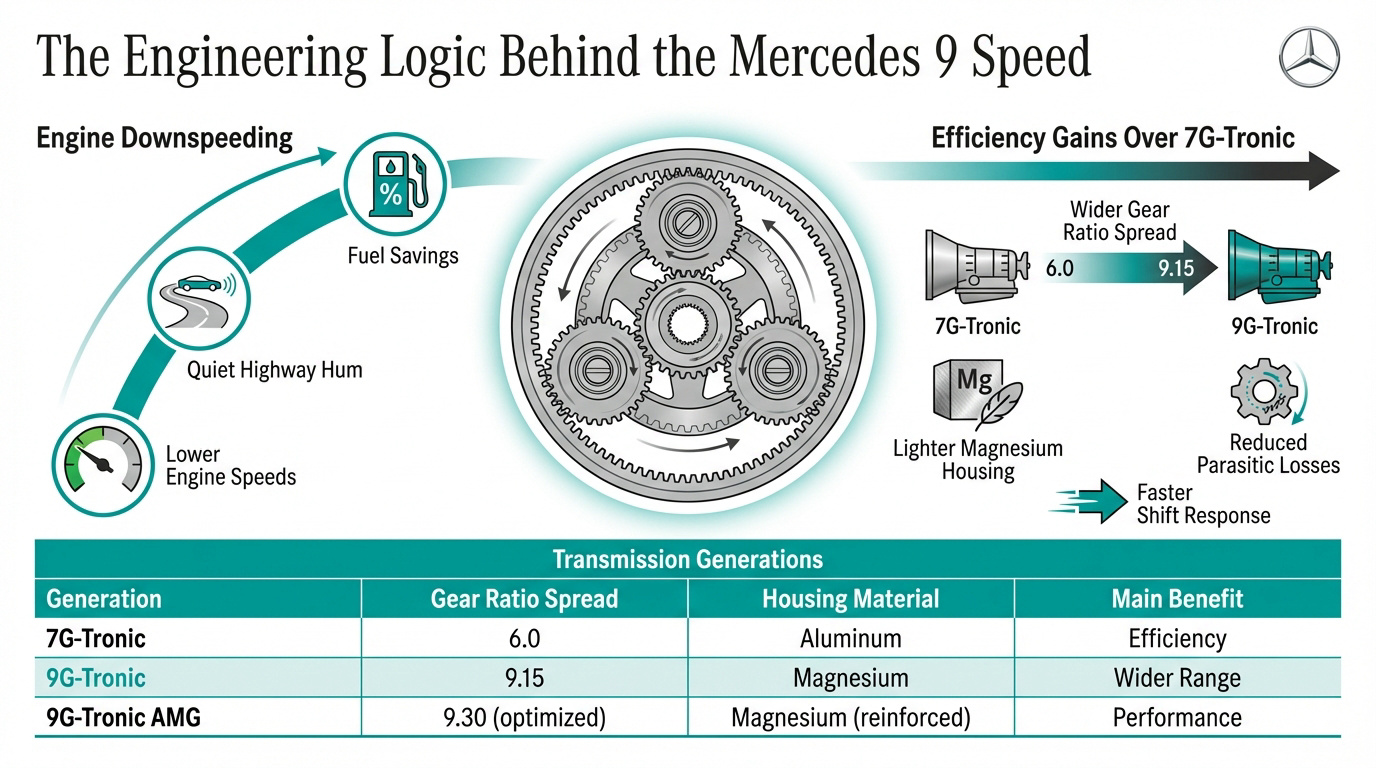
The Engineering Logic Behind the Mercedes 9 Speed
The transition from seven to nine gears represents a calculated evolution. Adding more ratios is a strategic move to enhance mechanical efficiency and driving dynamics.
Improving Fuel Economy via Engine Downspeeding
Downspeeding maintains low engine rotations. This technique reduces internal friction significantly. Consequently, the vehicle consumes less fuel during steady driving.
The 9th gear enables remarkably low RPM levels. At highway speeds, the engine hums quietly. This optimization ensures a refined and silent cabin environment.
Fuel savings reach up to 6.5 percent. These gains are evident during motorway journeys. Efficiency improves without compromising the available torque.
Operating costs remain low for the owner. This setup preserves power while maximizing fuel. It is a practical benefit for daily use.
Comparing Efficiency Gains over the 7G-Tronic
The 9G-Tronic offers a wider ratio spread. It features a shorter first gear and a taller top gear. Force est de constater que it outperforms the old 7-speed unit.
Weight reduction is achieved through magnesium alloy. This makes the transmission assembly lighter. It improves the overall vehicle balance and handling.
Mechanical efficiency is higher in the new design. Fewer moving parts reduce parasitic losses. This ensures more power reaches the wheels.
The response time is now significantly crisper.
| Generation | Gear Ratio Spread | Housing Material | Main Benefit |
|---|---|---|---|
| 7G-Tronic | 6.0 | Aluminum | Smooth shifting |
| 9G-Tronic | 9.15 | Magnesium | Fuel efficiency |
| 9G-Tronic AMG | 9.15 | Magnesium | Direct response |
Accessories for Your Mercedes
Enhance your BMW with our premium selection of accessories. Upgrade your interior with an Apple CarPlay / Android Auto module to enjoy a fully modern multimedia system.


Mechanical Architecture of the 9G-Tronic System
Understanding the internal mechanics of the Mercedes 9 speed requires a look at the actual gears and clutches inside the box.
Design Principles of the Planetary Gearset
The system uses four planetary sets to generate nine gears. This specific arrangement allows for a remarkably compact design. Despite having more ratios, the unit remains physically small.
Direct hydraulic control is managed by dedicated solenoids. These components act directly on the internal clutches. This streamlined approach speeds up the shifting process significantly compared to older designs.
A twin-turbine damper sits within the torque converter. This hardware effectively cancels out engine vibrations. It ensures that power delivery feels seamless to the driver during every transition.
Distinctions within the AMG Multi-Clutch Variant
The AMG Speedshift MCT swaps the fluid coupling for a wet clutch pack. This modification creates a direct mechanical link. It allows for much faster launches. The result feels more aggressive than the standard 9G-Tronic.
Rapid downshifts define the performance of this specific variant. The control unit can skip multiple gears instantly. Performance driving requires this level of precision during heavy braking or acceleration.
Removing the heavy torque converter saves significant rotating mass. This reduction allows the engine to rev more freely. It improves the overall throttle response.
How Does Dynamic Select Influence Shift Behavior?
The mechanical hardware of the 9G-Tronic provides the foundation, but the electronic systems ultimately dictate the driving personality of the vehicle.
Electronic Control Unit and Shift Quality
In Eco mode, the transmission hunts for the highest gear possible to reduce RPMs. Conversely, Sport mode holds gears longer to keep the engine in the powerband for better response.
The Transmission Control Unit constantly monitors throttle inputs. If the driver adopts an aggressive style, the software adapts the shift points to match those specific requirements immediately.
The "Race Start" function optimizes clutch engagement for maximum off-the-line acceleration. This is a thrilling feature specifically designed for owners of high-performance AMG models.
Even in the most aggressive settings, the electronic management ensures transitions remain precise. This oversight effectively prevents harsh jolts during rapid gear changes.
Role of the Electric Auxiliary Oil Pump
When the engine shuts off at a stoplight, the mechanical pump stops rotating. The electric auxiliary pump takes over immediately to maintain hydraulic pressure, allowing the car to move the instant the engine restarts.
Without this secondary pump, the transmission would feel sluggish during ECO start-stop cycles. It enables seamless transitions between stationary and moving states.
This pump ensures that critical components stay lubricated even when the internal combustion engine is not spinning. Such constant lubrication prevents premature wear on the planetary gearsets.
The integration of this auxiliary system is a clever solution. It helps the vehicle meet modern emissions standards without sacrificing drivability.
Maintenance Standards and Diagnostic Indicators
Shift the focus to ownership and how to keep this complex piece of machinery working perfectly.
Service Intervals for Transmission Fluid and Filters
Most 9G-Tronic units need fresh oil every 125,000 kilometers or five years. Do not ignore these deadlines if you want reliability. Regular maintenance prevents premature wear.
You must use Mercedes-approved ATF with the correct specification. Using the wrong fluid can damage the internal clutches and solenoids. The 9-speed system is sensitive to lubricant quality.
The oil filters are often integrated into the transmission pan. You usually replace the whole pan. This ensures a complete seal and fresh filtration.
This job requires specialized filling equipment for accuracy. Don't try this at home. Professional tools are mandatory for levels.
Symptoms of Valve Body and Electronic Failure
Rough shifting or jerking when coming to a stop are red flags. This often points to a failing valve body or worn solenoids. Changes may feel inconsistent or delayed.
The car might lock itself in gear to prevent further damage. This is a software-driven safety measure triggered by the electronic control module. It often limits the car to third gear.
A professional scanner is needed to read the specific fault codes. Don't guess the problem yourself. Codes like P073E00 or P07B700 confirm mechatronic issues.
Catching electronic glitches early can save you thousands in repair bills. Address warning lights immediately to avoid failure.
The Mercedes 9-speed transmission optimizes fuel efficiency through engine downspeeding while ensuring seamless power delivery via advanced planetary gearsets. Regular fluid maintenance is essential to preserve these mechanical gains. Upgrade your driving experience now by embracing this refined 9G-Tronic technology for a quieter, more economical future on the road.
FAQ
Why did Mercedes-Benz introduce a 9-speed transmission?
The primary objective of the 9G-Tronic transmission is to enhance fuel efficiency and driving performance. By increasing the number of gears from seven to nine, Mercedes-Benz allows the engine to operate within its most efficient power band more frequently. This engineering shift results in a reduction in fuel consumption of up to 6.5% while providing a smoother and more responsive driving experience.
How does the 9G-Tronic improve fuel economy through downspeeding?
The 9-speed configuration features a wider gear ratio spread, which enables the engine to run at significantly lower revolutions per minute during steady-state cruising. For instance, at 120 km/h, a vehicle may sit at approximately 1,350 rpm in ninth gear. This "downspeeding" reduces internal friction and fuel consumption, particularly during long-distance motorway travel, without sacrificing available power.
What are the main technical differences between the 9G-Tronic and the older 7G-Tronic?
The 9G-Tronic offers a broader ratio spread of 9.15 compared to the 6.0 spread found in the 7G-Tronic. This allows for a shorter first gear for better acceleration and a taller top gear for efficiency. Additionally, the 9G-Tronic is lighter due to its magnesium alloy housing and uses a simplified planetary gearset design with fewer components, which reduces parasitic losses and improves shift speeds.
What is the difference between the standard 9G-Tronic and the AMG Speedshift MCT?
While the standard 9G-Tronic uses a conventional torque converter for smooth power delivery, the AMG Speedshift MCT replaces it with a wet multi-clutch start-off element. This modification provides a direct mechanical link between the engine and the wheels, offering faster launches and more aggressive gear changes. The MCT version is specifically designed for high-performance driving and can skip multiple gears instantly during rapid deceleration.
Why does the Mercedes 9-speed transmission use an auxiliary electric oil pump?
The 9G-Tronic is equipped with both a mechanical main pump and an electric auxiliary oil pump. The electric pump maintains hydraulic pressure when the engine is shut off during ECO start-stop phases. This ensures that the internal components remain lubricated and that the transmission is ready to engage immediately when the engine restarts, providing seamless transitions in city traffic.
What are the recommended maintenance intervals for the 9G-Tronic system?
To ensure long-term reliability, the transmission fluid and filters typically require replacement every 125,000 kilometers or every five years. Because the oil filters are often integrated into the transmission pan, the entire pan is usually replaced during service. It is essential to use Mercedes-approved ATF fluids to prevent damage to the internal clutches and sensitive electronic solenoids.
What are the common symptoms of a failing transmission valve body or electronics?
Common indicators of mechanical or electronic distress include rough shifting, hesitations, or jerking when the vehicle comes to a stop. In some cases, the electronic control module may trigger a "limp mode," locking the transmission in a single gear to prevent further internal damage. If these symptoms occur, a professional diagnostic scanner is required to identify the specific fault codes within the Transmission Control Unit.