


Encountering a bmw right low beam malfunction warning on your dashboard immediately raises concerns regarding vehicle safety and potential repair expenses.
The essential takeaway: The "low beam malfunction" alert indicates a circuit anomaly, ranging from a standard burnt bulb to a critical FEM/FRM module error. Conducting a simple left-to-right bulb swap immediately isolates the fault source. Prompt intervention is crucial, as the electronic system may permanently lock the headlight output after repeated short-circuit detections, necessitating specialized professional resetting.
This article analyzes the technical causes behind this alert, distinguishing between standard bulb failures and more serious issues within the electronic control modules. You will discover precise diagnostic methods to isolate the problem and evaluate the most cost-effective solution for restoring full visibility.
- Decoding the BMW Low Beam Malfunction Warning
- Starting With the Basics: Bulb and Fuse Checks
- Beyond the Bulb: Investigating Electrical Faults
- The Electronic Brain: FEM and FRM Module Faults
- Estimating Repair Costs and Warranty Questions
Decoding the BMW Low Beam Malfunction Warning
What That Dashboard Light Is Really Telling You
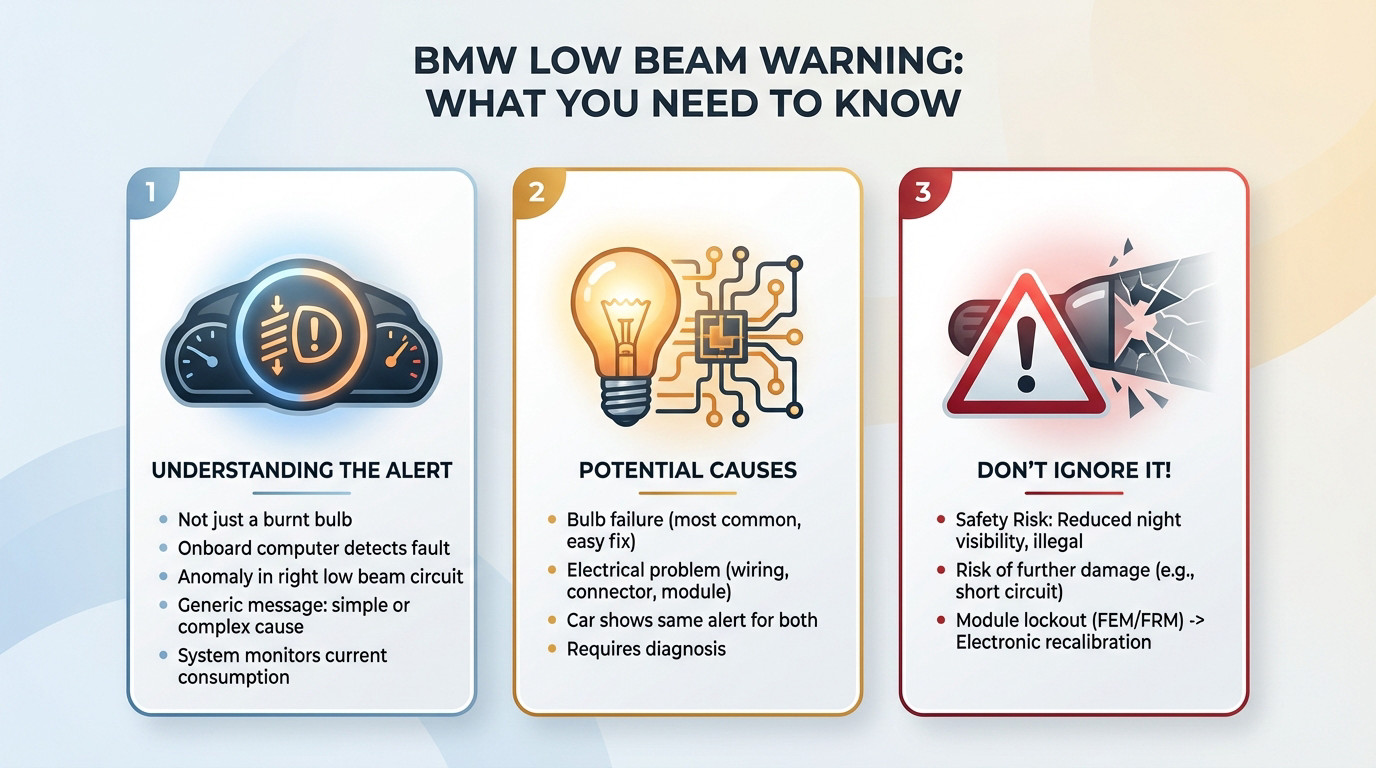
This alert signifies much more than just a simple burnt-out bulb. It indicates a specific fault detected by the onboard computer within the lighting system. The system has identified a distinct irregularity within the right low beam's electrical circuit.
This message remains intentionally generic on the dashboard display. The root cause ranges from a minor fix to a complex electrical issue.
BMW's electronic management system is highly sophisticated. It constantly monitors the current consumption of every lighting component. Even a slight variation in voltage or resistance triggers the specific bmw right low beam malfunction warning immediately.
Is It Just a Bulb or Something More?
A burnt filament remains the most probable culprit for this issue. Replacing the bulb usually resolves the error message quickly. This scenario represents the simplest and most frequent cause found in these vehicles.
Yet, a electrical problem often mimics the exact same symptoms. Faulty wiring, corroded connectors, or a failing control module might be at play.
The vehicle does not distinguish between these failures on the main screen. The warning light looks identical for a cheap bulb or an expensive electronic module. The initial diagnostic must determine the exact nature of the failure.
Why Ignoring the Warning Is a Bad Idea
Driving with one functioning headlight poses a significant safety risk. It drastically reduces visibility at night for the driver. Operating such a vehicle is also illegal in most jurisdictions.
Unresolved electrical issues lead to further complications over time. A lingering short circuit or voltage spike can eventually damage other expensive components.
Modern BMW lighting modules (FEM/FRM) count these fault occurrences. The system may permanently lock the circuit after a certain number of failures. This turns a basic repair into a job requiring electronic recalibration by a specialist.
Starting With the Basics: Bulb and Fuse Checks
Halogen vs. Xenon/HID: Knowing Your Headlight Type
Not all BMWs are equipped with the same headlights. It is paramount to identify the technology used before attempting any repair. A bmw right low beam malfunction diagnosis depends entirely on this specific distinction.
The halogen headlights typically utilize standard H7 bulbs. These components are simpler in design, less expensive to replace, and emit a light that appears more yellowish.
Xenon/HID headlights, often using D1S bulbs, produce a very bright white or bluish light. They require a complex system with a ballast to function effectively. Consequently, the diagnostic method differs significantly. You cannot treat them like standard filaments.
The Simple Swap Test to Confirm a Bad Bulb
There is a pragmatic diagnostic method available to isolate the issue. Before purchasing a new replacement, it is advisable to exchange the bulb from the right headlight with the working one from the left. This represents the most direct verification approach.
Analyze the result of this physical swap carefully. If the failure migrates to the left side, the conclusion is undeniable. The bulb is indeed the culprit causing the lighting failure.
However, if the right headlight remains dark even with the known good bulb from the left, the problem lies elsewhere. It is then necessary to look further into the electrical system.
Don't Forget the Fuse Box
Fuses are designed to safeguard electrical circuits from overloads. A blown fuse remains a plausible cause, although it occurs less frequently than a defective bulb. It warrants a quick visual inspection.
Note that the location of the fuse box and the specific headlight fuse varies according to the BMW model.
Verify the following points regarding the fuse condition:
- Is the fuse visually blown with a broken filament?
- Are there visible signs of corrosion on the contacts?
- Is the component seated firmly within its designated slot?
Beyond the Bulb: Investigating Electrical Faults
If the bulb and fuse are ruled out, it is time to look at the more complex electrical components that power the headlight.
Understanding the Role of the Headlight Ballast
This component specifically concerns Xenon/HID systems found in many vehicles. The ballast acts as a high-voltage transformer within the assembly. It converts the car's 12V supply into thousands of volts to ignite the xenon gas.
A defective ballast represents a very common cause of xenon headlight failure. Like any electronic part, it degrades and eventually fails over time.
- The headlight flickers noticeably upon ignition before shutting off completely.
- The light output changes color or takes on a distinct pink hue.
- An audible buzzing or humming noise emanates directly from the headlight unit.
Wiring and Connectors: The Weak Links
The engine compartment constitutes a hostile environment for delicate electronics. Intense heat cycles and constant vibrations degrade cable insulation over time. This deterioration frequently leads to intermittent short circuits or loose connections within the harness.
Connectors plugging into the bulb and ballast can also corrode or melt due to moisture. A thorough visual inspection typically reveals this physical problem immediately.
Consider the specific case of adaptive headlights. The constant movement of the projector wears down internal wiring. Consequently, a failure might occur solely during cornering maneuvers.
When to Suspect a Wiring Issue
Intermittent faults serve as a key symptom for diagnosis. If the bmw right low beam malfunction occurs sometimes but not always, it signals a bad contact.
If the alert appears when driving over a bump or turning the steering wheel, wiring is the number one suspect. Physical movement triggers the fault.
Tracing a wiring problem proves quite tedious. It involves following the harness from the headlight back to the control module. Technicians must look closely for signs of wear, burn marks, or severed cuts.
The Electronic Brain: FEM and FRM Module Faults
Sometimes, the root of a lighting issue lies not in the bulb itself, but in the sophisticated computer managing the current.
What is the Front Electronic Module (FEM/FRM)?
The FEM (Front Electronic Module) or FRM (Footwell Module) operates as the central command unit for the vehicle's body electronics. This computer controls the operation of power windows, exterior mirrors, and, most critically, the entire lighting system.
This component does far more than act as a simple switch for the lamps. It actively monitors the status of every bulb, checking for voltage irregularities and resistance in real-time.
Manufacturers designed this intelligent module to strictly protect the electrical system. In the event of a recurring short circuit on a headlight, it decides to permanently cut the power supply to that line to prevent extensive electrical damage.
The Short-Circuit Counter Lockout
A stubborn bmw right low beam malfunction often involves a protective feature known as the short-circuit counter. The control module diligently records every electrical fault, incrementing an internal tally each time the circuit fails to complete properly.
Once this digital count hits a critical threshold—usually set at 50 events—the computer shuts down that specific output channel completely. This safety measure is irreversible without intervention.
Consequently, the headlight will not function even after you replace the bulb or fix the wiring. The system remains in a "lockout" state until the software is told otherwise.
Resetting the Module: When Professional Help is Needed
Resetting a locked FEM/FRM is not a standard DIY maintenance task. It necessitates specific diagnostic equipment and proprietary BMW software capable of accessing the deeper coding layers of the vehicle's computer.
A certified mechanic must hook up to the OBD port to formally reset the short-circuit counter, effectively telling the car it is safe to send power again.
It is vital to repair the physical wiring fault before attempting this reset. If the root cause remains, the module will detect the surge and lock the circuit again, rendering the service useless.
Estimating Repair Costs and Warranty Questions
Once the diagnosis confirms a bmw right low beam malfunction, the inevitable question concerns the financial impact. The following breakdown details potential expenses, ranging from the simplest fixes to the most complex repairs.
DIY vs. Professional Repair: A Cost Breakdown
Repair expenses fluctuate significantly based on the specific failed component and whether the owner opts for self-repair or professional service. Avoiding unnecessary labor charges can save hundreds, but specific tasks require expertise.
| Component | DIY Cost (Parts Only) | Independent Shop Cost (Parts & Labor) | Dealership Cost (Parts & Labor) |
|---|---|---|---|
| Halogen Bulb (H7) | $20 - $40 | $75 - $150 | $150 - $250+ |
| Xenon Bulb (D1S) | $70 - $150 | $200 - $350 | $350 - $500+ |
| Xenon Ballast | $100 - $250 | $300 - $500 | $500 - $800+ |
| Wiring Repair | N/A (Highly variable) | $150 - $400 (diagnostic included) | $250 - $600+ |
| FEM/FRM Module Reset/Repair | N/A | $200 - $500 | $400 - $1000+ |
These figures represent estimates that differ according to the specific BMW model and geographical location. While a DIY approach offers substantial savings for simple bulb replacements, complex electronic failures often necessitate professional intervention.
Are BMW Headlights Covered Under Warranty?
Determining coverage relies heavily on the specific nature of the failure and the type of warranty currently active on the vehicle. Not all lighting issues receive the same administrative treatment.
Standard light bulbs are classified as wear-and-tear items, similar to brake pads or tires. Consequently, factory warranties rarely cover their replacement unless a premature failure occurs immediately after purchase.
Conversely, failures involving major components such as a ballast, a FEM/FRM module, or internal wiring defects typically fall under the manufacturer's "bumper-to-bumper" warranty, provided the vehicle remains within the eligible period.
Choosing the Right Parts: OEM vs. Aftermarket
Owners must decide between OEM (Original Equipment Manufacturer) components, which match factory specifications, and aftermarket alternatives. OEM parts are those installed at the factory, ensuring perfect compatibility and longevity.
Aftermarket options, manufactured by third-party companies, frequently present a lower price point. However, the quality consistency varies significantly, posing a potential risk for sensitive electronic systems.
- For complex electronic components like the ballast or FEM, sticking to OEM parts is safer to avoid recurring errors.
- For bulbs, reputable aftermarket brands (Philips, Osram) are often an excellent compromise between cost and performance.
Addressing a BMW low beam malfunction requires a systematic approach. While a burnt bulb remains the most common cause, owners must not overlook potential wiring issues or control module faults. Prompt diagnosis ensures safety on the road and prevents costly electronic damage to the vehicle's sophisticated management systems.
FAQ
What causes the right side low beam to fail on a BMW?
The most frequent cause of a right side low beam failure is a burnt-out bulb, whether it is a standard halogen or a Xenon HID unit. However, in BMW vehicles, the issue often extends to other components such as a defective headlight ballast or damaged wiring insulation within the headlight assembly. In more complex cases, the Footwell Module (FRM) may cut power to the circuit permanently if it detects repeated short circuits, requiring professional resetting or replacement.
What is the estimated cost to repair a BMW headlight?
Repair costs fluctuate significantly depending on the underlying issue and the type of headlight technology. Replacing a simple halogen bulb typically costs between $20 and $50 for the part. However, replacing a Xenon HID bulb or a failed ballast can range from $150 to over $500, especially if Original Equipment Manufacturer (OEM) parts are selected. If the repair involves the electronic control module or extensive wiring work at a dealership, costs can exceed $1,000.
What triggers an adaptive headlight malfunction?
Adaptive headlight malfunctions generally stem from failures in the swivel motors that direct the light beam or the control unit responsible for managing the system. The wiring inside the headlight housing is also prone to degradation due to heat and constant movement, which can lead to short circuits. This warning typically appears when the system fails its self-diagnostic check upon startup or when the vehicle attempts to adjust the lights during a turn.
Is a bad relay typically responsible for low beam failure?
Unlike older vehicles, modern BMWs do not utilize traditional relays to control individual low beams. Instead, power distribution and circuit monitoring are managed electronically by the Footwell Module (FRM) or the Front Electronic Module (FEM). Consequently, a "bad relay" is rarely the cause of the problem; the fault usually lies within the control module's logic, the wiring harness, or the lighting component itself.
Do auto parts stores perform headlight repairs?
Major auto parts retailers generally do not perform mechanical or electrical repairs. While they sell replacement bulbs and may assist with installing a simple halogen bulb if the housing is easily accessible, they are not equipped to diagnose complex electrical faults, replace ballasts, or recode control modules. For malfunctions that persist after a simple bulb swap, professional diagnosis by a mechanic is necessary.
What is the replacement cost for a headlight control unit?
Replacing a main control unit, such as the FRM or FEM, represents a significant repair expense. The module itself often costs between $300 and $600. When including the labor for installation and the mandatory electronic programming to initialize the module to the vehicle, the total cost at a specialized independent shop or dealership typically falls between $600 and $1,200.
Does the warranty cover BMW headlight malfunctions?
Warranty coverage depends on the specific component causing the failure. Light bulbs are classified as wear-and-tear items and are rarely covered under the standard factory warranty. However, defects in major components [...] are typically covered under the new vehicle limited warranty or Certified Pre-Owned (CPO) warranty, provided the vehicle remains within the eligibility period.
Accessories for Your BMW
Enhance your BMW with our premium selection of accessories. Upgrade your interior with an Apple CarPlay / Android Auto module to enjoy a fully modern multimedia system.


