




The essential takeaway: This warning signals a malfunction in the Dynamic Stability Control (DSC) system, frequently caused by failing wheel speed sensors or low battery voltage. Although the vehicle remains drivable, critical safety interventions are disabled, necessitating moderate speeds. A diagnostic OBD-II scan provides the only reliable method to pinpoint the specific electronic or hardware fault.
Encountering a chassis stabilization malfunction on your BMW immediately restricts driving dynamics and indicates a fault within the safety systems. This analysis identifies the primary triggers for this alert, distinguishing between minor software glitches and significant hardware failures like wheel speed sensors. The following sections outline precise diagnostic methods to help you resolve the issue and regain full control of your car's stability features.
- What That Chassis Stabilization Warning Actually Means
- Starting with the Simple Stuff: Glitches and Power Issues
- The Usual Hardware Culprits: Sensors and Wires
- When the Problem Runs Deeper: Control Module Failures
- Understanding the Bigger Picture and What to Do Next
What That Chassis Stabilization Warning Actually Means
It's Your Car's Safety Net Acting Up
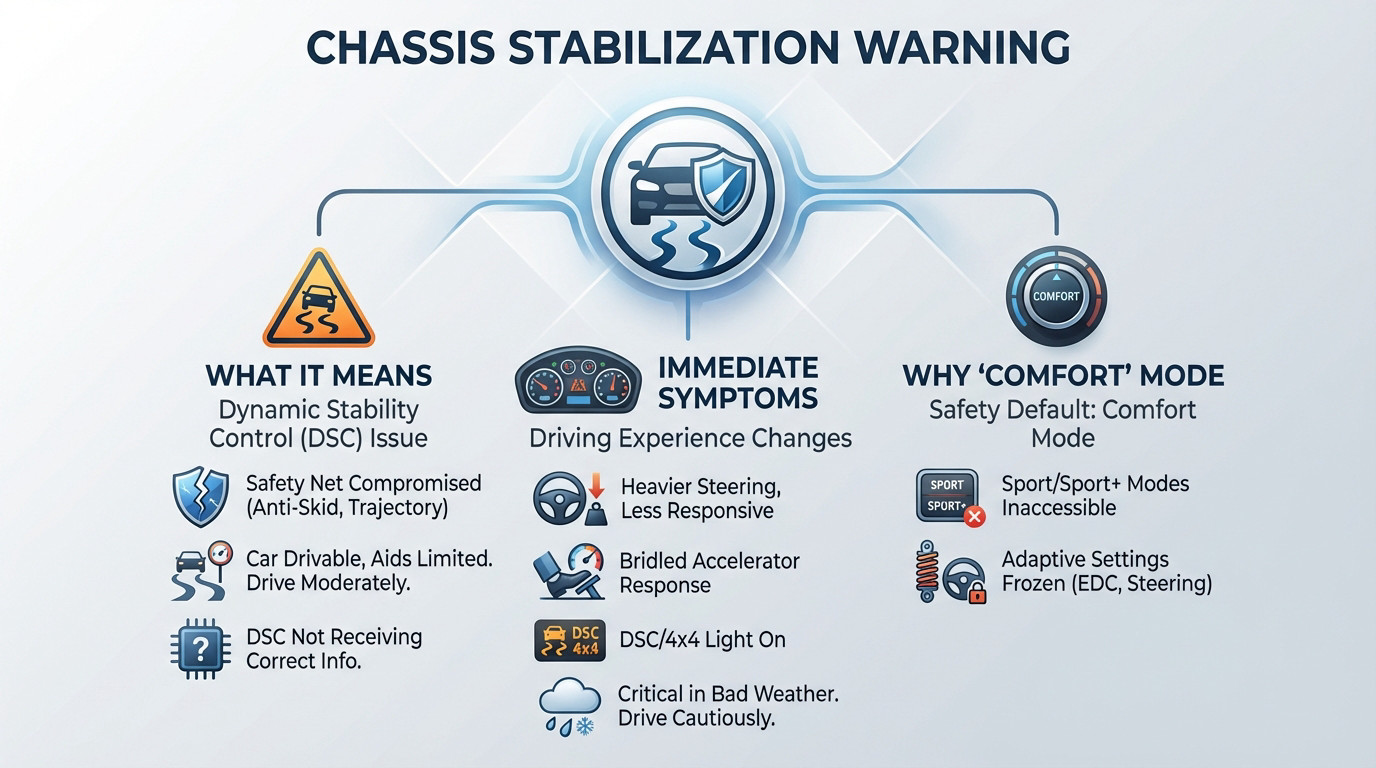
The "chassis stabilization malfunction" alert points to a specific issue with the Dynamic Stability Control (DSC) system. This isn't an engine failure, but the mechanism preventing skids is compromised. Consequently, the vehicle's ability to maintain its intended trajectory is reduced.
You can still drive the car, but electronic aids correcting driver errors are deactivated. The warning "Drive Moderately" serves as a literal instruction for safety. Without these interventions, handling becomes strictly manual.
The DSC system acts as the electronic brain managing traction and stability. This alert signifies it is no longer receiving accurate data.
Immediate Symptoms You Can't Ignore
Driving sensations often change noticeably during this malfunction. Steering might feel significantly heavier or less reactive to inputs. Additionally, throttle response is frequently restricted to prevent aggressive maneuvers.
A yellow DSC or 4x4 warning light usually illuminates on the dashboard alongside the text. This serves as visual confirmation that the stability system lies at the heart of the problem.
On wet or snowy roads, the loss of DSC becomes particularly notable. Drivers must exercise increased caution in these conditions.
Why You're Stuck In "Comfort" Mode
For safety reasons, the vehicle often locks itself into "Comfort" mode automatically. Modes like "Sport" or "Sport+" become inaccessible because they require a perfectly functioning chassis system.
This restriction also freezes adaptive suspension (EDC) or steering settings. It acts as a necessary protective measure for the vehicle's hardware.
The One Thing You Must Do: Read the Codes
Guesswork is expensive with these cars. You cannot accurately diagnose a chassis stabilization malfunction without seeing what the computer sees. An OBD-II scan is the only way to get the facts.
Even if the warning light disappears, the history remains. The specific error code is stored in the module's memory. This data is what guides the technician to the exact faulty part.

Check Engine Light On? Save Money by Reading Fault Codes at Home.
Scan any OBD2 vehicle in under 30 seconds with the Launch X431 CR319. Compact enough to live in your glove box, powerful enough to skip the dealership.
→ Get Your Diagnostic Scanner

Starting with the Simple Stuff: Glitches and Power Issues
Now that you understand what the alert means, we need to find the trigger. Often, the fix is much simpler than you might expect.
The Classic "Turn It Off and On Again" Trick
Sometimes, these warnings are just intermittent errors. You might find the alert vanishes completely after you simply shut down and restart the engine. It happens more often than you think.
This often points to a basic software glitch between control modules. If the error stays away, you likely have nothing to worry about right now. However, if it reappears, that is a clear sign of a real underlying problem.
Your BMW's Thirst for Consistent Voltage
Never underestimate the impact of your car's battery health. A weak battery is a frequent cause of phantom electronic messages on modern BMWs. These electronic modules remain incredibly sensitive to even minor voltage fluctuations.
A brief voltage drop during ignition is enough to trigger a chassis stabilization malfunction. The system panics without steady power.
You should test any battery over four years old immediately. This applies if errors pop up mostly during cold starts.
When the Error Is Just a Ghost in the Machine
For persistent software doubts, you can try a full system reset. Disconnecting the negative battery terminal for 15 minutes forces the modules to reboot. This clears temporary logic freezes.
But be warned, this is definitely not a magic repair solution. If a physical sensor is actually broken, the error will inevitably come back. You must treat this as a diagnostic step, not a permanent fix for the car.

The Usual Hardware Culprits: Sensors and Wires
If a restart or a new battery changes nothing, it is time to look at the most common hardware causes.
The Sensitive Sensors That Keep You Stable
The DSC relies on a sensor network to track vehicle behavior. If one unit sends false data, the whole system shuts down. This default mode prevents dangerous corrections.
A faulty wheel speed sensor often triggers this specific malfunction. It is closely tied to the ABS system.
You must examine the specific components that monitor traction data. A failure in any of these parts disables stability control immediately. Here are the primary suspects:
- Wheel Speed Sensors: Often dirty, corroded, or simply failed. They tell the car how fast each wheel is turning.
- Steering Angle Sensor: Informs the DSC of the steering wheel's position. A misalignment or failure here confuses the system.
- Brake Pressure Sensor: A fault in this sensor can also trigger a DSC error, as braking is a key part of stability control.
When the Problem Is in the Connections
Sometimes the sensor is fine, but the wiring harness fails. The wire connecting the unit to the control module might be damaged. Corrosion or a loose plug breaks the signal path. Rodents also chew these lines.
Wiring located near the wheel wells faces constant abuse. Water, road salt, and debris attack these exposed connections. Vibrations eventually cause the copper strands to snap.
How a Bad Wheel Alignment Throws Everything Off
Hitting a curb often causes significant trouble. A bad wheel alignment creates a mismatch between steering data and the car's path. The computer detects a conflict.
The DSC interprets this discrepancy as a loss of control. It triggers the fault code to warn the driver. If you hit a pothole recently, suspect this issue.

When the Problem Runs Deeper: Control Module Failures
The Brain of the Operation: The DSC/ICM Module
Let's look at the unit often labeled the Integrated Chassis Module (ICM) on newer Bimmers. It acts as the absolute central computer processing every scrap of sensor data. It decides exactly when to cut engine power. It also commands individual brakes to keep you straight.
While built tough, this hardware can actually fail internally over time. This creates persistent ghosts in the machine that basic code readers often miss. Many general mechanics struggle to catch this. They often blame sensors when the brain itself is actually dying.
Steering Problems Masquerading as a Chassis Issue
You might not suspect the Electronic Power Steering (EPS) module immediately, but you should. This system is tightly woven into the DSC network's logic. They constantly talk to each other while you drive.
A glitch inside the steering rack sends corrupt data upstream to the main unit. The central computer effectively panics at these nonsensical signals. Consequently, it lights up the chassis stabilization malfunction warning to protect you.
Comparing the Two Main Module Culprits
These two failures feel similar, but the root causes differ wildly. You need to know which expensive part is actually broken before approving repairs.
Here is how to distinguish between these critical component failures based on specific symptoms:
| Module | Typical Symptoms | Underlying Issue |
|---|---|---|
| ICM / DSC Module | Persistent "Chassis stabilization" error, multiple related system warnings (collision, pedestrian), error often intermittent at first. | Internal failure of the main stability computer. It's a central processing problem. |
| EPS Module / Steering Rack | "Chassis stabilization" error often accompanied by a heavy or notchy steering feel, sometimes a separate power steering warning. | A mechanical or electronic fault within the power steering system itself, which reports bad data to the ICM. |

Understanding the Bigger Picture and What to Do Next
Why Other Warnings Pop Up at the Same Time
The DSC unit does not just manage stability; it acts as a central data hub. It feeds real-time speed and trajectory stats to half the car's computers. When that data stream fails, dependent systems collapse instantly.
You might see your dashboard light up like a Christmas tree because these features rely entirely on that missing data:
- Collision Warning Malfunction: This system uses DSC data to prepare for an impact. If the data is bad, it shuts down.
- Pedestrian Warning Malfunction: Same principle, it relies on vehicle speed and trajectory data from the DSC.
- Active Cruise Control: Cannot function without reliable speed and stability information.
Your Immediate Action Plan
Take the "Drive Moderately" alert seriously. Without stability intervention, aggressive cornering or sudden acceleration can easily send the car sideways. You are driving without a safety net, so keep inputs smooth.
Do not panic, but follow this logical sequence to manage the situation safely before visiting a mechanic:
- Acknowledge the warning and drive cautiously, especially in poor weather.
- Try a simple vehicle restart at a safe location to check for an intermittent glitch.
- Note if any other warnings appeared at the same time and how the car feels.
- Plan to get the vehicle scanned for fault codes as soon as possible.

FAQ![]()
What does a "Chassis Stabilization Malfunction" warning indicate?
This warning signifies a fault within the vehicle's Dynamic Stability Control (DSC) system. It indicates that the electronic safety features designed to monitor traction and prevent skidding are either disabled or functioning with limited capabilities. The issue typically stems from faulty sensors, such as wheel speed sensors, or communication errors between control modules, rather than a mechanical engine failure.
Is it safe to continue driving with a chassis stabilization error?
The vehicle generally remains drivable, but the driver must exercise increased caution. The accompanying message often advises to "Drive Moderately," which is a critical safety instruction. Without an active DSC system, the car will not automatically correct for loss of traction or stability, making it more susceptible to sliding in wet conditions or during sharp turns.
How can the chassis stabilization system be reset?
For intermittent software glitches, simply turning the engine off and restarting the vehicle may clear the error. If the warning persists, disconnecting the battery for approximately 15 minutes can sometimes force a reset of the electronic modules. However, if the error is caused by a physical hardware failure, such as a damaged wire or sensor, the light will return until the specific component is repaired.
What are the potential costs to repair a chassis stabilization issue?
Repair costs vary widely depending on the root cause identified by a diagnostic scan. Replacing a simple wheel speed sensor is a relatively minor expense. Conversely, if the issue lies within a major component like the Integrated Chassis Module (ICM) or the electronic steering rack, costs can be significantly higher, potentially reaching several thousand dollars for parts and labor.