



The essentials to remember: The BMW parking lamp alert monitors circuit resistance, frequently signaling a dying bulb or oxidized connection before complete failure occurs. Inspecting the front "angel eyes" or position lights typically reveals the issue. Prompt replacement of the specific W5W or H6W bulb usually resolves the fault without expensive diagnostics.
Does the sudden appearance of a bmw parking light faulty warning on your dashboard indicate a simple burnt bulb or a deeper electrical failure within the monitoring system? This article details the technical triggers behind this specific alert, distinguishing between routine maintenance needs and the wiring issues that often affect these vehicles. Readers will discover a systematic systematic diagnostic approach to accurately isolate the defective component and restore the lighting system to full operation.
- Decoding the "Parking Lamp Malfunction" Alert on Your BMW
- The Most Frequent Culprits Behind the Fault
- Investigating Deeper Electrical Issues
- A Systematic Approach to Troubleshooting
- Resolving the Error and Post-Repair Steps
Diagnosing a BMW parking light faulty warning
What This Specific Warning Actually Signals
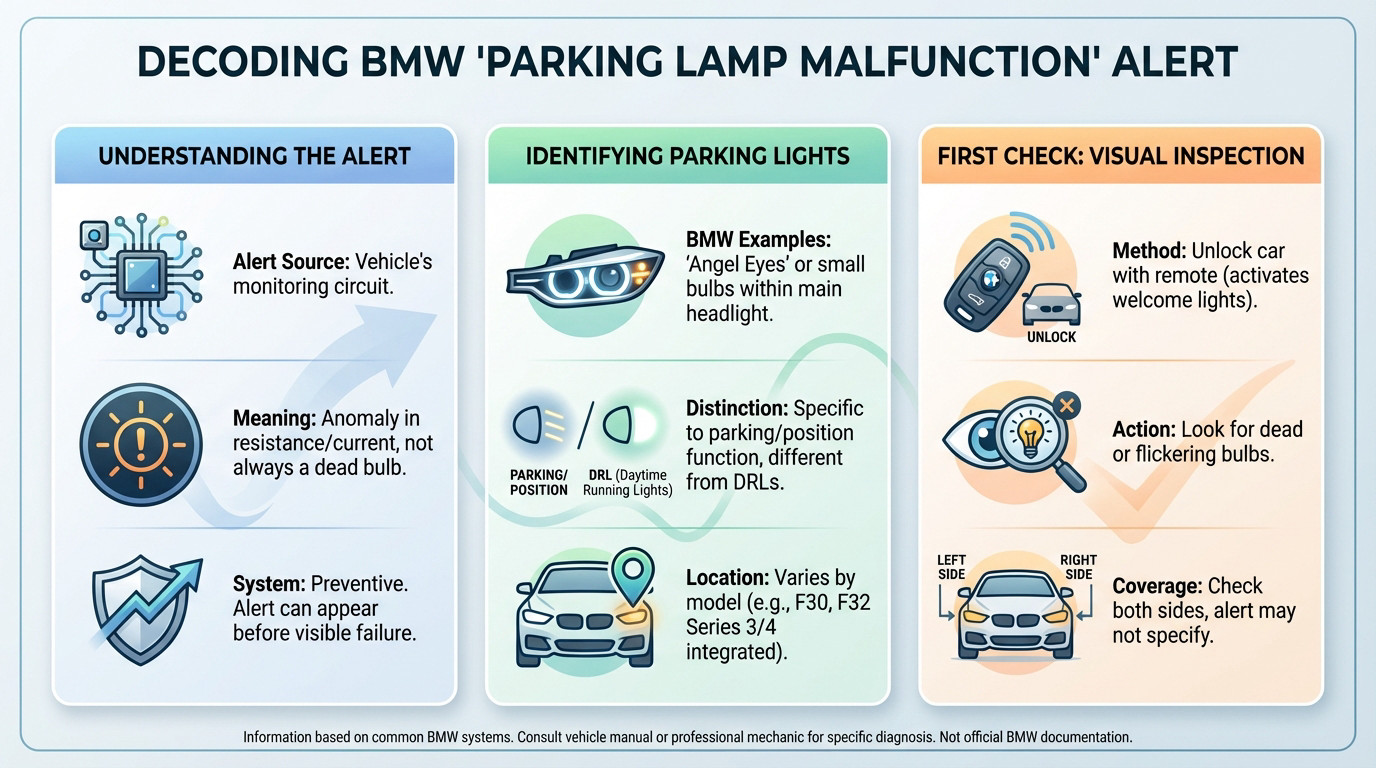
You hear that chime and assume a dead bulb immediately. But a bmw parking light faulty alert isn't always that straightforward. It is actually the vehicle's monitoring circuit flagging a specific anomaly.
This system hates resistance changes or current fluctuations. A slight drop often signals an impending failure before the filament actually snaps. That is why the warning pops up even if the light still glows. It is designed to be preventative.
Because of this hair-trigger sensitivity, diagnostics must go deeper than a glance. You have to look past the glass bulb itself.
Distinguishing Parking Lights from Other Front Lights
Let's get the terminology straight regarding these specific lights. We are usually talking about the "angel eyes" or a tiny bulb tucked inside the main headlight cluster. It is a distinct component.
Don't confuse these with your Daytime Running Lights (DRL). Even if they share hardware, "parking lamp" error targets a specific low-visibility function. The system knows the difference.
The exact spot depends heavily on your chassis code. On the F30 and F32 platforms, these are integrated tightly into the front headlight assembly.
The Initial Visual Check: A Simple First Step
Here is a trick that saves time immediately. Unlock your car using the key fob while standing in front of it. The "welcome lights" feature powers up the parking circuit immediately. You will instantly spot if one side is dim or flickering.
Walk around and inspect both sides of the front bumper. The dashboard alert rarely distinguishes left from right, so you must look closely.

The Most Frequent Culprits Behind the Fault
The Classic Case: A Failing or Burnt-out Bulb
Let's be real, the most likely issue is a simple burnt-out bulb. These components are standard wear parts with a finite lifespan. Eventually, they just give up the ghost.
Before dying completely, a bulb often struggles, causing resistance fluctuations in the circuit. This instability is exactly what triggers that annoying bmw parking light faulty warning on your dashboard.
Even if it still glows faintly, the bulb is likely on its way out. You should treat it as the primary suspect immediately.
Beyond the Bulb: The Problem of Oxidized Contacts
Sometimes the bulb is fine, but the connection is the real enemy here. Moisture and air inevitably attack the metal points within the bulb holder or connector. This chemical reaction creates a layer of oxidation. Consequently, you get a poor electrical connection.
These oxidized contacts significantly increase electrical resistance within the socket. Your BMW's sensitive monitoring system misinterprets this resistance spike as a dead bulb, throwing an error code.
A simple cleaning often works. Just twist it to scrape the corrosion.
When Aftermarket Bulbs Cause Interference
You must be careful with cheap aftermarket replacements, especially low-quality LED or HID units. These parts often lack the precise engineering found in OEM components. They simply don't match the car's specs.
Because they draw different power, they confuse the vehicle's delicate monitoring circuit. The system expects specific resistance, doesn't find it, and triggers a false alarm immediately.
Investigating Deeper Electrical Issues
If the problem stems neither from the bulb nor the contacts, one must address more complex electrical causes requiring careful inspection.
Loose Connections Within the Wiring Harness
Road vibrations affect the wiring harness integrity over time. These constant tremors often loosen the pins inside the headlight connector. Consequently, the electrical path becomes unstable.
A loose connection creates an intermittent contact. This causes the bmw parking light faulty error to appear and disappear sporadically. The bulb itself might flicker during operation.
Visual inspection of the connector remains a necessary diagnostic step when other causes are discarded. It confirms physical integrity.
The Notorious Grounding Issue and Connector Damage
A grounding issue plagues many BMW models. The brown wire frequently carries more current than it can handle safely. This overload leads to rapid overheating. It represents a significant design vulnerability.
One should search for signs of thermal stress. Look for burnt marks or melted plastic on the headlight connector. These damages are a clear indicator of ground failure.
The following table outlines common faults to assist in accurate troubleshooting. It categorizes issues by symptom.
| Problem | Symptom | Typical Complexity |
|---|---|---|
| Loose Connection | Intermittent warning, light flickers | Medium |
| Oxidized Contacts | Warning is constant but light may work | Low |
| Grounding Issue | Burnt smell, visible damage on connector | High |
| Faulty Light Module | Warning persists with new bulb, other lights may fail | High |
A Faulty Light Control Module (FRM) as the Source
The FRM, or Footwell Module, represents a possible cause, albeit rarer. This electronic unit manages the entire vehicle lighting system. It processes inputs and controls outputs for every lamp.
An internal malfunction of the light control module generates erroneous signals. This triggers the alert even if the bulb and wiring are in perfect condition. Such a diagnosis typically necessitates specialized equipment.

A Systematic Approach to Troubleshooting
Identifying the Correct Bulb Type for Your BMW
Using the exact bulb reference prevents annoying false dashboard alerts. A mismatch often triggers the sensitive monitoring system. The owner's manual remains the definitive source for this data.
Here are the standard specifications found in models like the F30 or F32:
- W5W (also known as 501): A very common wedge-type bulb used in many applications.
- T10: Often used interchangeably with W5W, this is a standard for side markers and parking lights.
- H6W: A bayonet-style bulb found in the headlight assemblies of certain BMW models.
How to Inspect Connectors for Hidden Damage
You must physically check the bulb connector and the wiring harness for integrity. Disconnect the plug carefully to expose the internal contact points. A visual inspection reveals issues that generic software scans frequently miss.
Look for greenish deposits signaling active oxidation on the metal surfaces. Dark spots or melted plastic indicate severe overheating. These signs often explain a bmw parking light faulty error.
Verify that the metal pins stand perfectly straight and remain firm within the housing. A pin pushed back inside the connector often breaks the electrical circuit.
Understanding the Frustrating Intermittent Fault
An intermittent error message generates significant frustration for many owners. This behavior almost always points toward an unstable connection rather than a total failure. The circuit monitoring system detects these micro-interruptions.
Several physical factors cause these temporary disruptions in the electrical flow:
- A micro-crack in the bulb's filament, invisible to the naked eye.
- Early-stage corrosion on a contact point, causing fluctuating resistance.
- A loose pin in the wiring harness that only loses contact over bumps.

Resolving the Error and Post-Repair Steps
Why the Warning Message May Persist After a Fix
Swapping the defective part often feels like the finish line, but the dashboard alert might stay lit. This happens because the specific error code remains stored deep within the control module's memory. The system does not always auto-refresh immediately. It holds onto that data until told otherwise.
To scrub this persistent record, using a dedicated OBD2 diagnostic tool becomes necessary. These devices communicate directly with the onboard computer to acknowledge the repair. They effectively reset the system's status. Only then does the warning finally vanish.
DIY or Professional Help: Making the Right Call
Deciding between a home repair and a shop visit depends on the severity. A simple bmw parking light faulty bulb swap is within most owners' capabilities. However, chasing complex electrical gremlins requires a completely different skill set.
If you are unsure about your next move, consider these specific red flags. A professional should intervene immediately in the following scenarios:
- If the warning persists after replacing the bulb and cleaning the contacts.
- If you see any signs of burnt or melted plastic on the wiring harness.
- If you are not comfortable working with vehicle electrical systems.
- If multiple, unrelated electrical faults appear.
Can you do it yourself?
An OBD2 scanner is one of the most useful tools a vehicle owner can have. It allows you to read fault codes, identify the source of warning lights, and monitor vehicle data in minutes without visiting a repair shop.
Our OBD2 Diagnostic Scanner helps you diagnose problems faster, save money on diagnostics, and make more informed repair decisions.

Check Engine Light On? Save Money by Reading Fault Codes at Home.
Scan any OBD2 vehicle in under 30 seconds with the Launch X431 CR319. Compact enough to live in your glove box, powerful enough to skip the dealership.
→ Get Your Diagnostic ScannerA Note on Warranty Coverage and Potential Costs
Owners must understand the limits of their coverage regarding lighting. Bulbs are generally classified as wear and tear items by the manufacturer. Consequently, they are rarely covered by the standard factory warranty. This applies even if the vehicle is relatively new.
Financial impact varies significantly based on the root cause. A DIY bulb replacement costs pennies. Conversely, a full electrical diagnostic at a dealership is much more expensive.
Addressing the "parking lamp malfunction" alert primarily involves checking for burnt bulbs or oxidized contacts. While simple replacements often resolve the issue, persistent warnings might require professional diagnostic tools to reset the system. Prompt attention to these electrical faults ensures the vehicle remains safe and fully operational.

FAQ
How is a parking light failure on a BMW typically resolved?
The resolution process generally begins with a visual inspection of the specific bulb, as a burnt-out filament is the most frequent cause of this alert. Common bulb types involved include T10, H6W, or W5W, depending on the specific BMW model. If replacing the bulb does not clear the error, the socket contacts must be checked for signs of oxidation or corrosion.
In cases where the bulb and contacts are in good condition, the issue often lies within the wiring harness or the vehicle's grounding points. A loose connection or a degraded wire insulation can trigger the monitoring system. For persistent faults that resist standard troubleshooting, the problem may originate from the Light Control Module (FRM), requiring specialized diagnostic equipment.
What are the potential costs associated with repairing a parking light?
Repair costs vary significantly depending on the root cause of the malfunction. A simple bulb replacement is generally inexpensive, with parts costing a minimal amount, and can often be performed by the vehicle owner. However, if the vehicle is taken to a dealership, labor charges can increase the final bill, even for minor interventions.
Expenses rise considerably if the diagnosis reveals a deeper electrical issue, such as a damaged wiring harness or a faulty control module. In instances where the entire headlight assembly requires replacement due to internal wiring degradation, the cost can reach several hundred dollars. It is noted that bulbs are often classified as wear-and-tear items and may not be covered under standard manufacturer warranties.
What common issues affect BMW headlight assemblies aside from parking lamps?
Beyond parking lamp malfunctions, BMW headlight assemblies frequently encounter issues with moisture intrusion. This occurs when seals fail, allowing water to enter the housing and potentially damage internal electrical components and ballasts. This environment accelerates corrosion on contact points.
Another prevalent issue, particularly in older models, involves the degradation of the wiring insulation within the headlight housing. The protective coating on the wires can become brittle and crack over time, leading to short circuits. Owners of models equipped with "angel eyes" also report specific failures of the LED modules or the light guides that illuminate the halo rings.
Can auto parts retailers assist with parking light repairs?
Retailers of automotive parts primarily supply the necessary replacement bulbs and can help identify the correct reference, such as the W5W or H6W. Staff members may occasionally assist with the installation if the bulb is easily accessible without removing other components.
However, these retailers typically do not perform complex electrical diagnostics or repairs. If the "parking lamp malfunction" alert stems from a wiring fault, a corroded connector, or a control module error, professional mechanical service or a specialized technician is required to address the problem effectively.
Is addressing a parking lamp malfunction necessary?
Repairing a parking lamp is recommended to ensure the vehicle remains fully visible to other drivers, particularly when parked in low-light conditions. A fully functional lighting system is also a standard requirement for vehicle safety inspections in many jurisdictions.
Furthermore, the vehicle's onboard computer prioritizes this alert, displaying a persistent warning message or a triangle icon on the dashboard. This constant notification can be distracting and may mask other, more critical vehicle alerts that could arise. Resolving the issue restores the integrity of the vehicle's monitoring system.