



Essential takeaway: Modern start-stop systems utilize reinforced AGM/EFB batteries and polymer-coated bearings to mitigate the mechanical strain of frequent restarts. While urban driving can reduce fuel consumption by up to 12%, the system’s longevity relies on these heavy-duty components. Notably, a standard lead-acid battery will fail prematurely, whereas specialized hardware ensures durability over hundreds of thousands of cycles.
Are you concerned that the frequent engine cycles of the automatic start stop system might accelerate wear on your vehicle's internal components? We provide a detailed technical analysis of how modern engineering, from AGM batteries to polymer-coated bearings, ensures durability while achieving fuel savings of up to 12%. This guide explores the operational logic of these micro-hybrid systems and presents professional solutions for those seeking to manage or bypass the feature effectively.
- Automatic Start-Stop Systems: Operational Principles and Logic
- Reinforced Engine Components for High-Frequency Restarts
- Quantifying Fuel Efficiency and Emission Reductions
- Diagnostic Protocols and System Management Strategies
Automatic Start-Stop Systems: Operational Principles and Logic
You are waiting at a red light when your engine suddenly goes silent. This momentary pause often frustrates drivers, yet it represents a sophisticated pillar of modern German engineering designed to slash emissions.
Engagement Logic for Manual and Automatic Transmissions
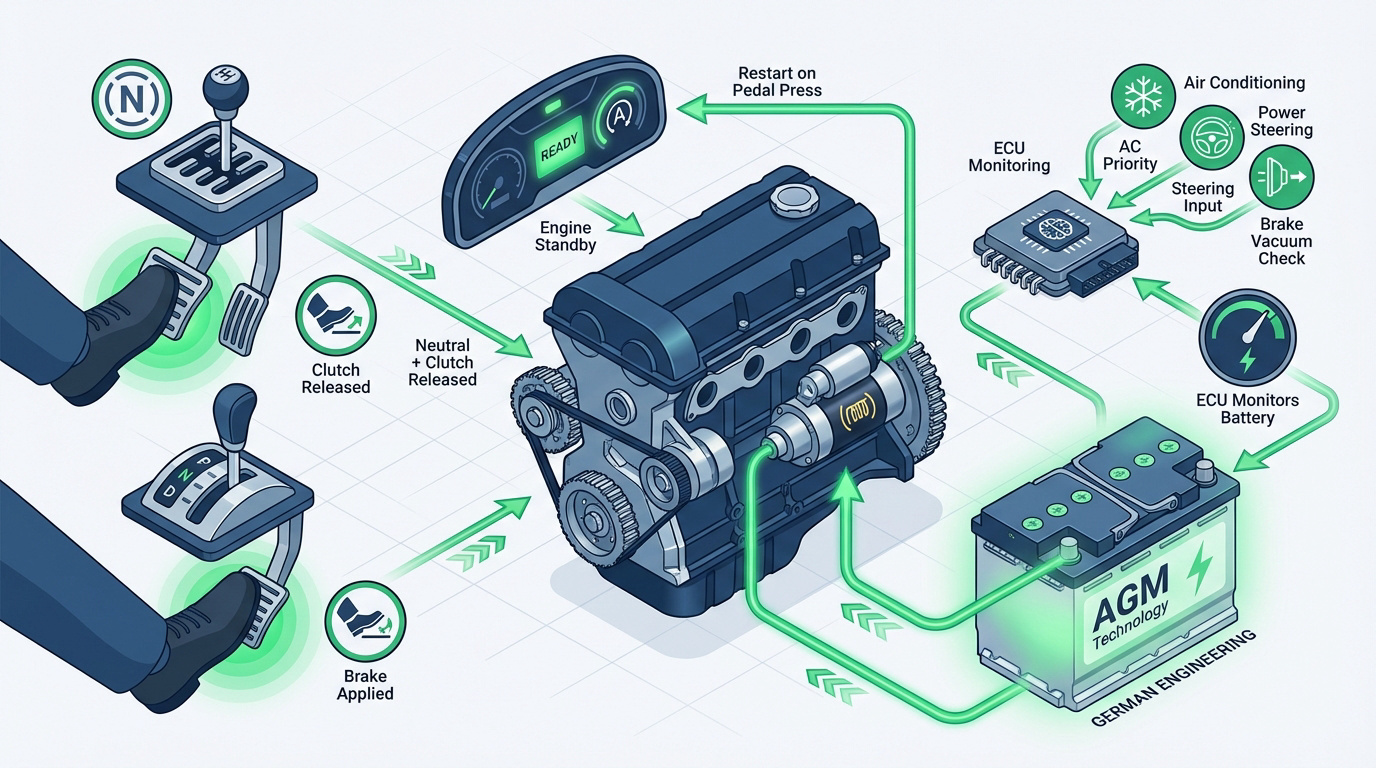
Manual cars require neutral gear and a released clutch. A sensor monitors this specific state. The engine restarts the moment you press the pedal.
Automatic logic relies on brake pedal pressure. The ECU detects a full stop. It then holds the engine in standby until you release the brake.
A "ready" light confirms the system is active. This dashboard symbol indicates the vehicle is waiting for your next input.
One system uses the left foot, the other the right. Both aim for maximum efficiency during your daily commute.
Monitoring Engine Load and Electrical Accessory Demand
The ECU constantly calculates the battery state. It ensures enough juice remains for a restart. If voltage is low, the engine stays on.
Air conditioning takes priority during summer. The engine might restart just to keep the cabin cool. The system balances comfort against fuel savings.
Power steering demand also matters. Turning the wheel triggers an immediate wake-up call. This ensures full assistance is always available.
Modern cars prioritize safety. If the brake vacuum drops, the motor fires up instantly. This guarantees reliable stopping power at all times.
While these systems reduce consumption by up to 12%, the mechanical strain is real. For those seeking to preserve their starter, we offer specialized automatic start-stop eliminators on our store to bypass this feature.
Reinforced Engine Components for High-Frequency Restarts
Transitioning from complex software logic to heavy-duty hardware is what actually makes these thousands of extra cycles possible without breaking your vehicle.
Specifications for AGM and EFB Battery Technology
Modern automatic start stop systems demand AGM or EFB batteries. Standard lead-acid units fail quickly because they cannot handle constant cycling. These advanced batteries manage deep discharges and rapid charging significantly better.
Absorbent Glass Mat designs hold the electrolyte in a glass fleece. This construction provides superior vibration resistance. It ensures much higher longevity, especially in high-performance German vehicles under heavy electrical load.
Technology comes at a price. These units are more expensive but mandatory. Installing a cheap, conventional battery will likely cause your system to malfunction or deactivate entirely.
The charging logic is also specialized. Your alternator works harder during deceleration phases. This specific strategy ensures these high-tech batteries stay topped up for the next engine restart.
Durability Upgrades for Starters and Crankshaft Bearings
Engineers utilize reinforced starter motors with stronger brushes and gear sets. These specific components are rated for hundreds of thousands of cycles. A standard starter would simply burn out within months under such intense operational stress.
Crankshaft bearings now feature specialized polymer coatings. This layer reduces friction during the critical "dry" start phase. It effectively protects internal metal surfaces while oil pressure is still reaching its optimal level.
Mechanical wear remains a valid concern for owners. Manufacturers apply these nano-composite coatings to ensure the engine block survives its extended duty cycle.
The solenoid mechanism is also significantly beefed up. It handles frequent gear engagement. This prevents the starter from sticking or failing prematurely during urban commutes.
Quantifying Fuel Efficiency and Emission Reductions
Transitioning from theory to road reality reveals how much automatic start stop technology actually impacts your wallet. Real-world savings often determine if the specialized hardware justifies its initial cost for the average owner.
Urban Efficiency and Real-World Savings Analysis
City data confirms that automatic start stop systems cut fuel consumption by 3% to 10%. In dense traffic, CO2 reductions help manufacturers meet strict fleet averages. It remains a measurable environmental win.
Modern fuel injection makes restarting more efficient than idling for over ten seconds. This debunked idling myth represents a mathematical victory for your fuel tank during every prolonged stop.
| Driving Scenario | Estimated Fuel Saving | Main Benefit | System Usage |
|---|---|---|---|
| Heavy Urban Traffic | 10-15% | CO2 | Very High |
| Suburban Commute | 5-8% | Fuel | Moderate |
| Highway/Motorway | 0% | None | Inactive |
| Stop-and-Go | 8-12% | Fuel | High |
While savings are verified, the sensation of the engine "dying" can be intrusive. Many drivers find this a small trade-off for improved efficiency.
Synergy Between Regenerative Braking and Micro-Hybrids
Micro-hybrid setups use alternators to recover kinetic energy during braking. This stored energy powers electronics when the engine is off, reducing battery load. It creates a clever loop where wasted heat becomes useful electricity.
Some models use supercapacitors for a quick power burst during restarts. This hardware ensures a smoother, faster transition than standard starters. It effectively bridges traditional combustion and full hybrid technology.
For total control, we offer automatic start stop eliminators in our store. These plug-and-play solutions bypass the system permanently, removing the need for manual intervention.
Diagnostic Protocols and System Management Strategies
Navigating the nuances of modern engine management requires a blend of technical insight and practical solutions, especially when the vehicle seems to develop a mind of its own. Transitioning from basic theory to real-world application, let’s look at how to troubleshoot inactivity and explore professional ways to reclaim control over your driving experience.
Identifying Environmental Triggers for System Inactivity
Common triggers often prevent the engine from cutting out during stops. Cold weather remains a primary factor here. The engine must reach a specific operating temperature to protect the catalytic converter.
The steering angle sensor also plays a major role. If you park with the wheels turned, the system stays active. It assumes a quick maneuver might be necessary for the driver.
Watch for dashboard symbols. A crossed-out 'A' icon typically indicates a condition isn't met. This is rarely a sign of a hardware failure.
Battery health is the most frequent culprit. As an AGM or EFB battery ages, the start-stop is the first feature disabled. This preserves essential cranking power.
Professional Hardware and Software Bypass Solutions
We offer "auto eliminators" in our store to solve this. These hardware modules remember your last manual setting. You no longer need to press the button every single journey. It is a seamless plug-and-play upgrade for German models.
OBDII coding remains a popular software-based alternative. Tools like VCDS or BimmerCode modify the default startup behavior. This approach permanently disables the feature through the vehicle's electronic brain.
Some drivers prefer mechanical peace. Others prioritize fuel savings. The choice is yours.
Always consider the warranty. Software modifications can leave digital traces that dealers might detect.
Mastering your automatic start stop system ensures peak fuel efficiency while preserving reinforced components like AGM batteries and polymer-coated bearings. Optimize your driving experience by monitoring battery health or utilizing plug-and-play eliminators for total control. Secure your vehicle’s longevity and efficiency today for a smoother, smarter journey tomorrow.
FAQ
How does the automatic start-stop system actually work in my vehicle?
The operational logic of an automatic start-stop system depends primarily on your transmission type. In manual vehicles, the engine typically shuts down when you shift into neutral and release the clutch pedal. For automatic transmissions, the system monitors brake pedal pressure; once a full stop is detected and sufficient pressure is maintained, the ECU places the engine in standby mode to conserve fuel.
In both scenarios, the system constantly evaluates environmental and mechanical factors. It checks if the engine has reached its optimal operating temperature and ensures the battery has enough charge to guarantee a reliable restart. As soon as you engage the clutch or lift your foot off the brake, the motor fires up instantly to ensure a seamless transition back to driving.
Can frequent engine restarts cause premature wear on internal components?
Modern engines equipped with this technology are specifically engineered to handle the increased frequency of start cycles. Manufacturers intégrer des démarreurs renforcés featuring heavy-duty brushes and gear sets designed for hundreds of thousands of cycles. Furthermore, critical components like crankshaft bearings are often treated with specialized polymer coatings to reduce friction during the "dry" phase before oil pressure fully builds up.
To further mitigate wear, these vehicles utilize advanced lubrication strategies. High-performance synthetic oils with specific additives are used to maintain a protective film on metal surfaces even when the engine is off. This technical synergy ensures that the legendary durability of your vehicle remains intact despite the high-frequency operational demands of the start-stop system.
Why does my engine sometimes stay running even when I am stopped?
It is common for the system to remain inactive if certain safety or comfort parameters are not met. The most frequent reason is battery health; if the voltage is too low to support both the electrical accessories and a guaranteed restart, the ECU will prioritize keeping the engine running. Similarly, during extreme temperatures, the system may stay off to prioritize air conditioning performance or to allow the engine to reach its necessary operating temperature.
Other triggers include the steering angle sensor or brake vacuum levels. If the wheels are turned at a sharp angle, the car assumes you may need to move quickly and keeps the power on. On your dashboard, a specific symbol—often a crossed-out "A"—will notify you that the conditions for an automatic shutdown have not been satisfied at that moment.
What are the real-world fuel savings provided by start-stop technology?
In urban driving environments and heavy stop-and-go traffic, the efficiency gains are measurable and significant. Data suggests fuel savings typically range between 3% and 10%, and can reach up to 12% in highly congested scenarios. This technology effectively eliminates the "idling myth," as modern fuel injection makes restarting the engine far more efficient than idling for more than ten seconds.
Beyond individual wallet savings, this system plays a crucial role in reducing overall CO2 emissions. By preventing billions of liters of fuel from being wasted annually during idling, it serves as a vital bridge between traditional internal combustion and full hybrid efficiency, particularly when paired with micro-hybrid features like regenerative braking.
Is it possible to permanently disable or bypass the start-stop feature?
For drivers who prefer a traditional experience without manual intervention every trip, professional solutions are available. We offer "auto eliminator" hardware modules that function as plug-and-play devices for many German models. These modules remember your last setting, effectively keeping the system off unless you choose to reactivate it, saving you from pressing the override button every time you start the car.
Alternatively, software-based adjustments can be made through OBDII coding tools like BimmerCode or VCDS. While these methods provide a permanent solution to disable the feature, we always recommend considering the potential impact on your vehicle's warranty. Whether you value mechanical peace of mind or maximum fuel efficiency, the choice to manage this technology is ultimately yours.