



The essential takeaway: Audi reliability now depends on balancing mechanical durability with software precision. While hardware like the Quattro system remains robust, digital complexity often causes sensor-related "ghost" errors. Prioritizing preventative maintenance and using diagnostic tools can prevent costly repairs, as simple software updates often resolve issues that appear mechanical, saving owners significant long-term expenses.
While premium engineering often suggests fragility, Audi reliability actually outpaces many German rivals through superior longevity and minimal cabin noise over high mileages. This article examines how the brand maintains its competitive edge in the used market by balancing mechanical masterpieces like the Quattro system with increasingly complex digital architectures. You will discover which specific engine pairings avoid common oil consumption issues and how proactive maintenance transforms these sophisticated machines into durable long term investments.
- Current State Of Audi Reliability And Brand Evolution
- Maintenance Costs And Repair Budget Expectations
- Selection Of The Most Dependable Audi Models In 2026
- Ownership Strategies For Maximizing Vehicle Lifespan
Current State Of Audi Reliability And Brand Evolution
Audi has long been synonymous with rigorous German engineering, yet the brand is currently navigating a significant shift from traditional mechanical mastery toward a complex digital reality.
Transition From Mechanical Focus To Software-Driven Systems
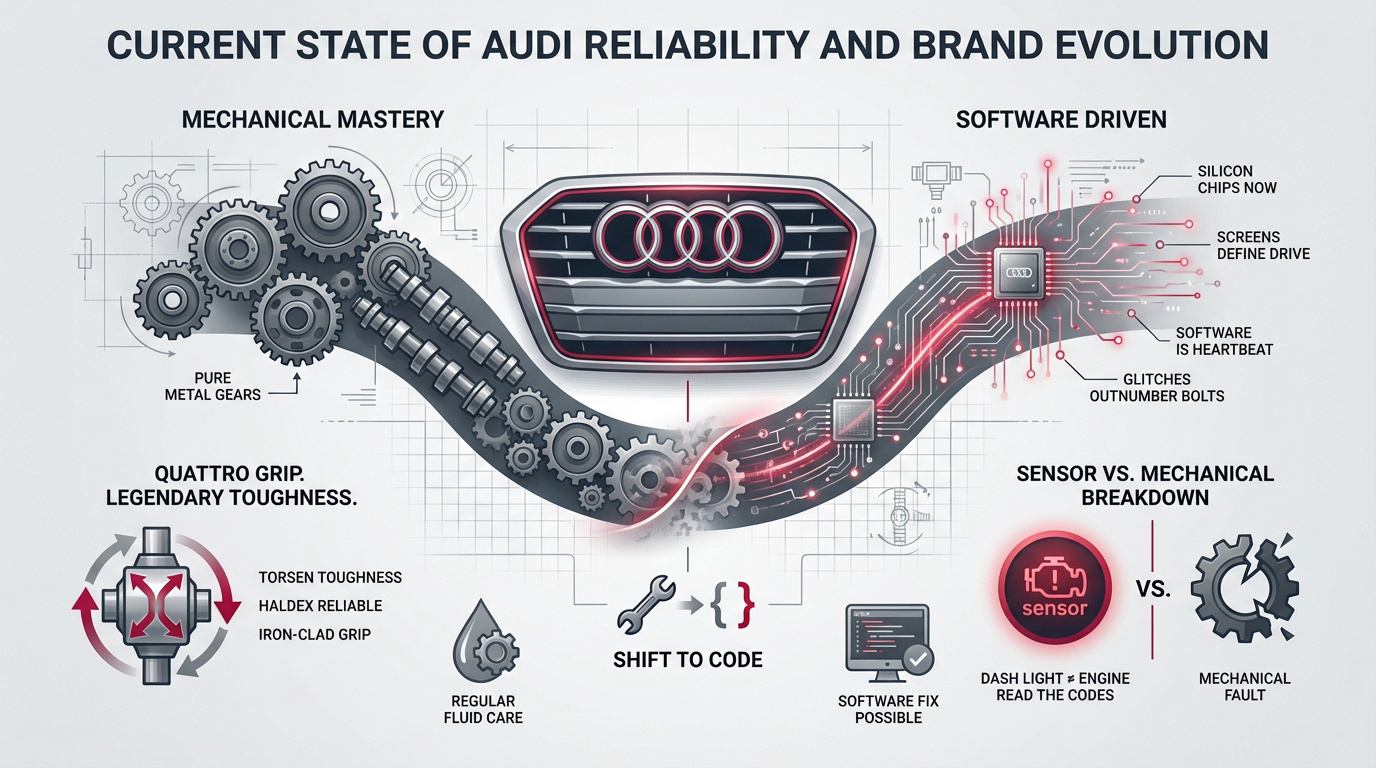
Audi transitioned from relying on robust metal gears to integrating sophisticated silicon chips. Modern luxury now depends heavily on complex lines of code to function correctly.
Digital screens and electronic modules define the contemporary driving experience. Software acts as the new heartbeat.
Digital glitches frequently cause more service visits than traditional broken bolts. This represents a major shift.
Durability Of The Quattro All-Wheel-Drive Engineering
The mechanical Torsen system is recognized for its legendary toughness. It remains a verified masterpiece of grip and long-term longevity.
Haldex systems found in smaller models also demonstrate strong durability. They require regular fluid changes to maintain optimal health.
Iron-clad reliability persists in this department. These iron gears rarely fail dedicated owners.
Differentiation Between Sensor Errors And Mechanical Breakdowns
A glowing dashboard light often indicates a failed inexpensive sensor rather than a total engine failure. Modern Audis are highly sensitive. A simple software flash can resolve many ghost problems without manual mechanical repairs.
Owners should learn to interpret diagnostic codes. This specific knowledge prevents unnecessary expenses.
Maintenance Costs And Repair Budget Expectations
Calculating the investment required to keep these vehicles on the road is essential for any owner.
Financial Gap Between Premium And Mass-Market Servicing
Audi oil changes cost more than Toyota services. Specialized synthetic oils and bespoke filtration drive up every invoice. Precision engineering requires expensive specific tools.
Labor rates at German specialists remain high. Owners pay for expertise in complex European systems. High performance carries a higher price for routine care.
| Service Type | Audi Cost | Mass-Market Cost | Frequency |
|---|---|---|---|
| Synthetic Oil Change | $150-$250 | $60-$90 | 10k Miles |
| Brake Pad Service | $300-$500 | $150-$250 | 40k Miles |
| Transmission Flush | $400-$700 | $200-$350 | 50k Miles |
| Spark Plug Service | $200-$400 | $100-$200 | 50k Miles |
| Diagnostic Scan | $100-$200 | $50-$100 | As Needed |
Role Of High-Grade Performance Parts In Vehicle Health
Cheap components are a financial trap. High-performance engines demand exact tolerances. Choosing OEM+ parts saves money over the vehicle's total lifespan.
Quality seals prevent catastrophic failures. One bad part can ruin an entire system. Never skimp on hardware; your Audi deserves the best gear.
Identifying Mechanical Red Flags During The Initial Test Drive
Listen for timing chain rattle on cold starts. Watch for jerky shifts in S-Tronic gearboxes. Smoky exhaust is a deal-breaker.
Feel for vibrations through the steering wheel. Suspension work is common but pricey. Always use a diagnostic scanner for hidden codes.
Selection Of The Most Dependable Audi Models In 2026
Identifying the right vehicle requires a clear transition from general maintenance costs to specific models that offer the best return on investment for long-term ownership.
Proven Longevity Of The A3 And A6 Sedan Platforms
The A3 is a solid entry point. Its MQB bones are shared with reliable cousins. It handles high mileage with grace.
The A6 is the highway king. Its build quality remains top-tier for years. It is a true executive tank.
Reliability Assessment Of The Q3 And Q5 SUV Lineups
The Q5 is Audi's best-seller for a reason. Recent model years have ironed out early bugs. It is a safe bet for families.
Q3 models offer simpler tech. Less complexity usually means fewer things break. It is a smart choice.
These SUVs hold their value. Reliability is the key driver here.
Optimal Engine And Transmission Pairings For High Mileage
Seek out the 2.0 TDI for pure endurance. It is a workhorse that loves long trips. Pair it with a manual or a well-maintained DSG. The 3.0 V6 engines are also stout if the chains are serviced.
Avoid early CVT transmissions at all costs. They are weak links in the chain. Stick to the Quattro setups.
Ownership Strategies For Maximizing Vehicle Lifespan
Adopting proactive habits remains the most effective method to protect your investment and ensure your Audi remains a reliable companion.
Impact Of Preventative Maintenance On Long-Term Value
Don't wait for the car to complain. Change fluids before the manual says so. Fresh oil is significantly cheaper than replacing a damaged turbocharger or engine components.
Keep a detailed service log. This history adds thousands to the resale price. Buyers love a paper trail that proves the vehicle received consistent, high-quality care throughout its life.
Prioritizing Mechanical Repairs Over Electronic Upgrades
Fix the oil leak before buying fancy wheels. A fast car that won't start is useless. Focus on the mechanical core first to ensure basic vehicle dependability and safety.
Cosmetic fixes can wait until next year. The engine and brakes are your top priorities. Stay safe by addressing wear in critical systems before considering any aesthetic modifications.
Drive the car, don't just look at it. Mechanics over aesthetics always.
Best Practices For DIY Maintenance And Cost Control
Buy a dedicated OBDII scanner for German cars. This tool pays for itself in one use. You can clear codes and reset service lights yourself. Many small jobs like air filters are easy to do at home.
Join owner forums for specific tips. The community knows every trick in the book. Save your big budget for the pros when handling complex internal mechanical repairs.
Modern Audi reliability relies on balancing robust mechanical engineering with complex software systems. To secure your investment, prioritize preventative maintenance and use diagnostic tools to address sensor alerts early. Act now to maintain peak performance and enjoy a dependable, premium driving experience for years to come.
FAQ
Are Audi vehicles generally considered reliable?
Audi is widely recognized as a dependable brand within the luxury segment. The manufacturer often maintains an advantage over its German competitors regarding long-term durability and the minimization of cabin noise as the vehicle ages. High-quality interior craftsmanship and advanced onboard systems also contribute to strong resale value on the secondary market.
However, the increasing technological complexity of modern models can lead to specific electronic or digital failures. While the mechanical cores are robust, entry-level models such as the A1 or Q2 may occasionally feature less refined interior finishes compared to the brand's higher-end offerings due to production cost management.
Which Audi models are the most dependable for long-term ownership?
Several models stand out for their consistent performance and build quality. The Audi A3, particularly in its recent Sportback and Sedan iterations, and the Audi A6 are noted for their longevity. In the SUV category, the Q3 is frequently cited for its reliability, alongside the Audi TT sports car.
Regarding engineering, the TDI diesel and TFSI gasoline engines are highly regarded when maintained correctly. Furthermore, the Quattro all-wheel-drive system is praised for its mechanical resilience and effectiveness across various driving conditions.
How can I distinguish between a sensor error and a serious mechanical failure?
The color of the dashboard warning light is the primary indicator of urgency. Green or blue lights signify active systems, while yellow lights indicate a problem requiring prompt attention. A red light represents a critical failure, such as engine overheating or a braking system malfunction, and necessitates an immediate and safe stop of the vehicle.
Sensor-related alerts, such as the TPMS for tire pressure or "Audi pre sense," often involve electronic components measuring specific data. In contrast, a "check engine" light or a battery warning usually points to broader mechanical issues like an alternator failure or emissions problems. Consulting the owner's manual is essential for a precise diagnosis of these indicators.
What are the most common electronic issues found in modern Audis?
Common electronic challenges include persistent dashboard warning lights caused by software glitches or faulty sensors, and occasional malfunctions in the central locking system or electric windows. Some owners also report infotainment screen instability or battery drainage while the vehicle is parked, often due to defective modules or hidden power consumption.
To prevent these issues, it is recommended to regularly check for moisture around electrical connectors and ensure that HVAC drains are clear. Utilizing a dedicated diagnostic tool can help identify and clear minor "ghost" codes before they lead to more significant repair requirements.
What specific mechanical problems should I look for in used Audi models?
Certain models have identified patterns that buyers should monitor. For instance, some Q2 and Q5 models may exhibit high oil consumption at higher mileages. Older A3 and A4 models (pre-2005) with the 2.0L 140 hp engine may face cylinder head issues, while A4 models produced between 2008 and 2015 might experience flywheel failures affecting the clutch.
Potential buyers should also inspect the water pumps on A3 TDI 150 hp versions and be aware of emissions-related recalls for specific A8 4.2 TDI models. Conducting a professional diagnostic scan and reviewing the full service history are vital steps in identifying these risks before purchase.
Is the Quattro all-wheel-drive system reliable?
The reliability of the Quattro system depends on its configuration. The Torsen-based systems are purely mechanical and are considered exceptionally robust due to their lack of complex electronics or hydraulic pumps. They provide permanent traction but may result in slightly higher fuel consumption and tire wear.
The Haldex system, used in models with transverse engines, relies on an electronically controlled hydraulic clutch. While more fuel-efficient, it requires regular fluid changes and may be susceptible to hydraulic pump failures over time. Both systems are highly effective, but the Torsen variant is generally favored for pure mechanical simplicity.