




The essential takeaway: The passenger restraint system malfunction alert signals a critical fault, often stemming from a defective passenger occupancy sensor mat, which forces the vehicle to disable the passenger airbag. This fail-safe protocol leaves the front passenger vulnerable during a collision. Therefore, immediate professional diagnosis is required to identify the specific error and restore essential safety features.
A sudden bmw passenger restraint system malfunction alert on the dashboard signals a potential compromise in the vehicle's safety features. This overview details the common technical causes, including seat sensor failures and wiring issues, that trigger this specific warning light. Identifying the root of the problem ensures the correct restoration of the airbag system and maintains optimal protection for all occupants.
- Understanding the Passenger Restraint System Warning
- Common Causes Behind The BMW Restraint System Fault
- The Direct Impact on the Airbag System
- Assessing the Situation: Can You Drive Your BMW?
- Recommended Actions When the Warning Appears
Understanding the Passenger Restraint System Warning
What This BMW Alert Signifies
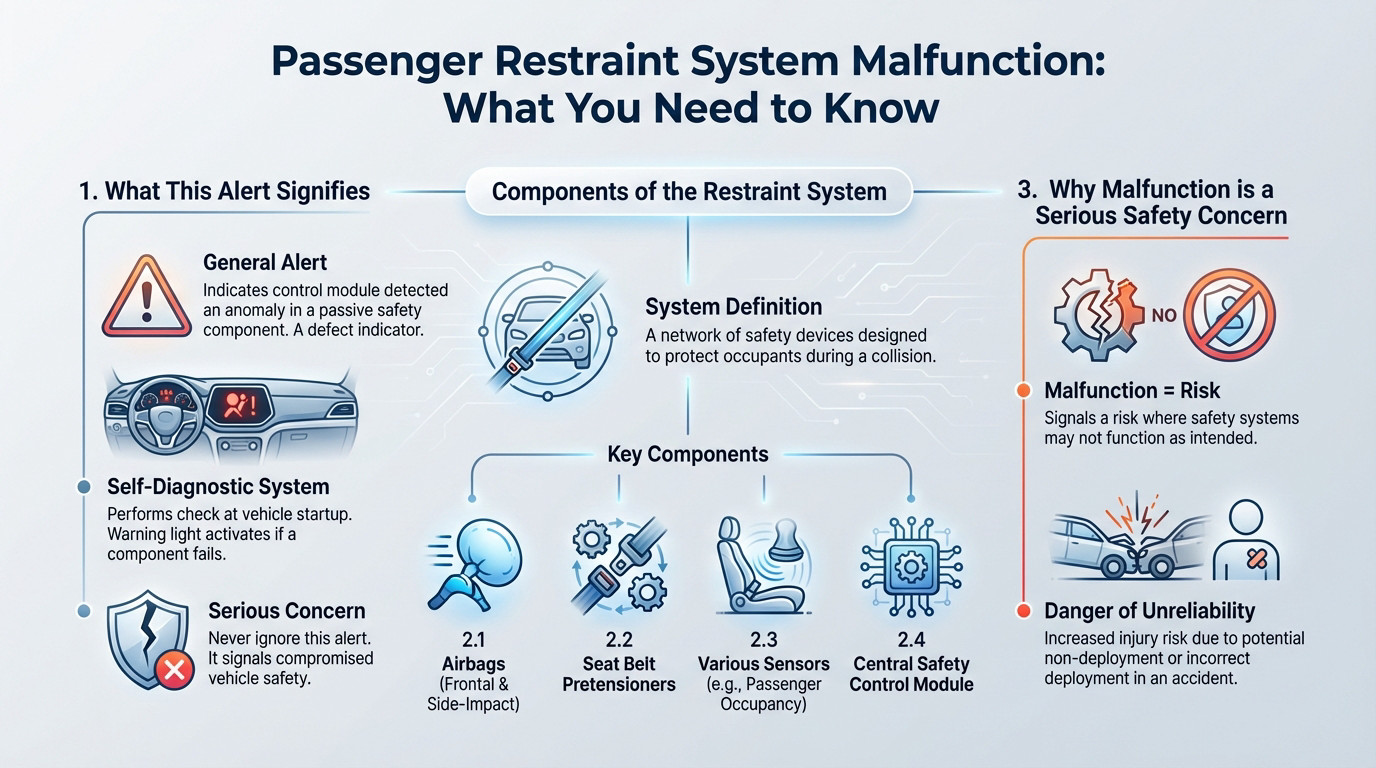
The bmw passenger restraint system malfunction message is a general alert. It indicates that the vehicle's control module has detected an anomaly in one of the passive safety components. It acts as a fault indicator rather than a specific diagnosis.
This system performs a self-diagnostic check every time you start the engine. If a component fails to respond correctly, the warning light illuminates to inform the driver of a potential failure.
Never ignore this alert. It signals that your safety is compromised.
Components of the Restraint System
The restraint system is a network of safety devices. These are designed to protect occupants during a collision. It involves much more than just the seatbelts you buckle daily.
This integrated safety loop relies on several hardware pieces. The computer monitors specific parts to keep you safe. If one element fails, the warning triggers immediately. The system tracks these specific items for faults:
- The airbags, including frontal and side-impact bags.
- The seat belt pretensioners, which tighten the belts in a crash.
- Various sensors, such as the passenger occupancy sensor.
- The central safety control module that manages these components.
Why the Malfunction is a Serious Safety Concern
The primary function of this alert is signaling immediate risk. A malfunction means one or more of these safety systems might not function as intended. You are driving without full protection.
The main danger here is unreliability. In an accident, the system might not deploy at all or could deploy incorrectly. This drastically increases the risk of severe injury.

Common Causes Behind The BMW Restraint System Fault
The Primary Suspect: The Passenger Occupancy Sensor Mat
The most frequent culprit is the passenger occupancy sensor mat embedded within the seat cushion. This component serves a singular purpose: detecting if someone is sitting there. It measures weight to signal presence. Without it, the car is blind.
That data dictates whether the passenger airbag should arm itself for a crash. Over years of use, the delicate sensor grid often cracks or fails completely. It simply wears out.
This specific defect is well-documented across numerous BMW models. It is a known weak point.
Distinguishing From Other Seat-Related Warnings
Owners often confuse two distinct alerts. A simple seat belt reminder is not the same as a full system failure. You must differentiate between them to understand the risk.
The former might just be loose wiring under the seat. However, the "restraint system malfunction" points to a deeper flaw in the safety circuit. It usually involves the sensor mat or the airbag module itself.
Other Potential Fault Triggers
While the sensor mat takes the blame often, other culprits exist. Detailed diagnostic scans frequently reveal unexpected triggers beyond the seat assembly.
- A low battery voltage, which can cause various electronic modules to report errors upon startup.
- Loose or corroded connectors under the passenger or driver's seat, interrupting the signal flow.
- A faulty seat belt pretensioner or buckle switch.
- A problem with the airbag module itself.

The Direct Impact on the Airbag System
The Consequence of a System Fault: Airbag Deactivation
Let's be blunt here: the single most dangerous outcome of this alert is immediate airbag deactivation. It is not just a nuisance light on your dash; it represents a total shutdown of the primary frontal safety mechanism for your co-pilot.
Specifically, when the passenger seat occupancy sensor malfunctions—often due to moisture in the seat mat—the vehicle cannot confirm an adult's presence. To prevent a catastrophic error, the computer automatically cuts power to the passenger airbag.
Understanding the System's Fail-Safe Protocol
You have to understand the engineering logic behind this. The control module is hard-coded to trigger a "fail-safe" protocol whenever data becomes unreliable. It chooses the path of least resistance to avoid an accidental or dangerous deployment during a drive.
In this context, keeping the bag stowed is safer than firing it into a rear-facing child seat or an empty spot. So, the system disables the passenger airbag circuit completely until the specific bmw passenger restraint system malfunction is diagnosed and repaired.
What This Means for Passenger Protection
The implication is terrifyingly simple. As long as that warning light remains illuminated, you must assume your front passenger is traveling without frontal airbag protection.
If a head-on collision occurs, only the seatbelt pretensioner will activate to restrain them. Consequently, the overall safety net is severely compromised, drastically increasing the statistical probability of life-altering injuries compared to a fully functional system.

Assessing the Situation: Can You Drive Your BMW?
Driving with an Active Restraint System Warning
Can you actually drive when the bmw passenger restraint system malfunction alert pops up? Technically, the car remains operational. The engine, transmission, and braking systems function without any mechanical interference.
However, operating the vehicle with this warning active is strongly discouraged, particularly with a passenger. Doing so means accepting a level of safety degraded for everyone inside. The protection systems might fail during an accident, increasing injury risks.
How Serious is This Malfunction? A Summary
To summarize the gravity of the situation, one must distinguish between driving capability and occupant protection. From a purely mechanical standpoint, the issue is minor and does not hinder movement.
Regarding safety, the problem is considered major. It directly compromises one of the vehicle's primary defense mechanisms against severe injury during a collision.
| Aspect | Severity Level | Implication |
|---|---|---|
| Vehicle Drivability | Low | The car operates normally; engine and braking systems are unaffected. |
| Passenger Safety | High | The passenger airbag is likely disabled, creating a significant safety risk in a collision. |
| Legal/Insurance | Moderate to High | Driving with a known safety defect could have insurance implications in case of an accident. |
| Urgency for Repair | High | The issue should be addressed promptly to restore full safety features. |

Recommended Actions When the Warning Appears
The Necessity of a Professional Diagnosis
You might suspect the seat mat sensor, but that is just a hypothesis. To truly address a bmw passenger restraint system malfunction, you need a professional electronic diagnosis. Only this process identifies the specific error code and pinpoints the actual failure.
Throwing parts at the car based on hunches wastes money. A qualified technician connects a dedicated scanner to read the safety module's memory, ensuring the repair targets the root cause rather than a symptom.
Understanding Technical Service Bulletins (TSB)
A Technical Service Bulletin, or TSB, is essentially a communication sent directly from the manufacturer to dealership service departments. It isn't a recall, but it serves as a technical guide.
These documents detail known defects and outline specific repair procedures for affected models. If a TSB exists for your restraint system, it implies BMW acknowledges the fault, potentially saving you from paying for unnecessary diagnostic time.
Immediate Do's and Don'ts
When that warning light hits your dashboard, your reaction determines the safety of your passengers. Here is the protocol.
- Do schedule an appointment with a qualified service center for a diagnostic scan.
- Do avoid placing items on the passenger seat that could interfere with sensors.
- Don't ignore the warning light; it will not fix itself.
- Don't attempt to clear the code without addressing the root cause, as it will reappear and mask a real safety issue.
Addressing a passenger restraint system malfunction is crucial for maintaining vehicle safety. Since this alert often signifies deactivated airbags, the risk to occupants increases significantly. Owners should prioritize a professional diagnosis to identify the specific fault, ensuring the complete restoration of the BMW's protective features.

FAQ
Why does the BMW display a passenger restraint system malfunction warning?
The most frequent cause for this specific alert is a defective passenger seat occupancy sensor mat. This component, integrated into the seat cushion, detects weight to determine if the airbag should be active, but it is prone to failure due to wear or internal micro-cracks.
Other technical triggers include loose or corroded wiring connectors under the seat, a faulty seat belt pretensioner, or low battery voltage affecting the safety module. A professional diagnostic scan is required to identify the specific error code.
What does a restraint system malfunction indicate?
This message signifies that the vehicle's central safety module has detected a fault within the passive safety network. This network comprises the airbags, seat belt tensioners, and various impact sensors designed to protect occupants during a collision.
When this warning appears, the system signals that one or more components failed the self-diagnostic check. It serves as a notification that the safety features are compromised and may not function as intended during an accident.
Is it safe to drive with a restraint system malfunction active?
From a mechanical standpoint, the vehicle remains drivable as the engine, transmission, and braking systems function normally. However, operating the vehicle with this warning is strongly discouraged, particularly when carrying passengers, due to the degraded safety status.
The primary risk is that the safety systems, specifically the frontal airbags, may fail to deploy during a crash. Driving in this condition implies accepting a significantly higher risk of severe injury for occupants in the event of a collision.
How critical is a passenger restraint system malfunction?
This malfunction is considered a high-severity safety issue. The system's fail-safe protocol typically disables the passenger airbag to prevent accidental or dangerous deployment, leaving the front passenger unprotected against frontal impacts.
While the issue does not affect the car's reliability for daily transportation, the lack of active safety features requires immediate attention. Prompt repair by a qualified technician is necessary to restore full occupant protection standards.