


The bottom line: 4MATIC is Mercedes-Benz’s proprietary name for its intelligent all-wheel-drive system. By automatically distributing power to all four wheels, it significantly enhances traction and stability in adverse weather conditions. Modern iterations like 4MATIC+ can even shift 100% of torque between axles, providing a critical safety advantage without sacrificing performance.
Grasping exactly what 4matic means uncovers how Mercedes-Benz engineering actively distributes power to all four wheels to guarantee superior traction on slippery surfaces. You will discover the specific mechanics behind this intelligent system and see why this technology justifies its cost through enhanced stability and performance.
- What 4Matic Really Means for Your Drive
- Not All 4Matic Systems Are Created Equal
- The Practical Side: Cost and Availability
What 4Matic Really Means for Your Drive
So, What Is The 4Matic Badge's Meaning?
It is the name for Mercedes-Benz's all-wheel-drive system. Unlike a standard car sending power to two wheels, this setup feeds all four wheels. That is its primary function.
The goal is improving traction and stability. It is not just there to look good on the trunk lid.
It is an intelligent system. It adapts constantly to road conditions to offer the best possible adherence.
The Benefits: Traction and Stability
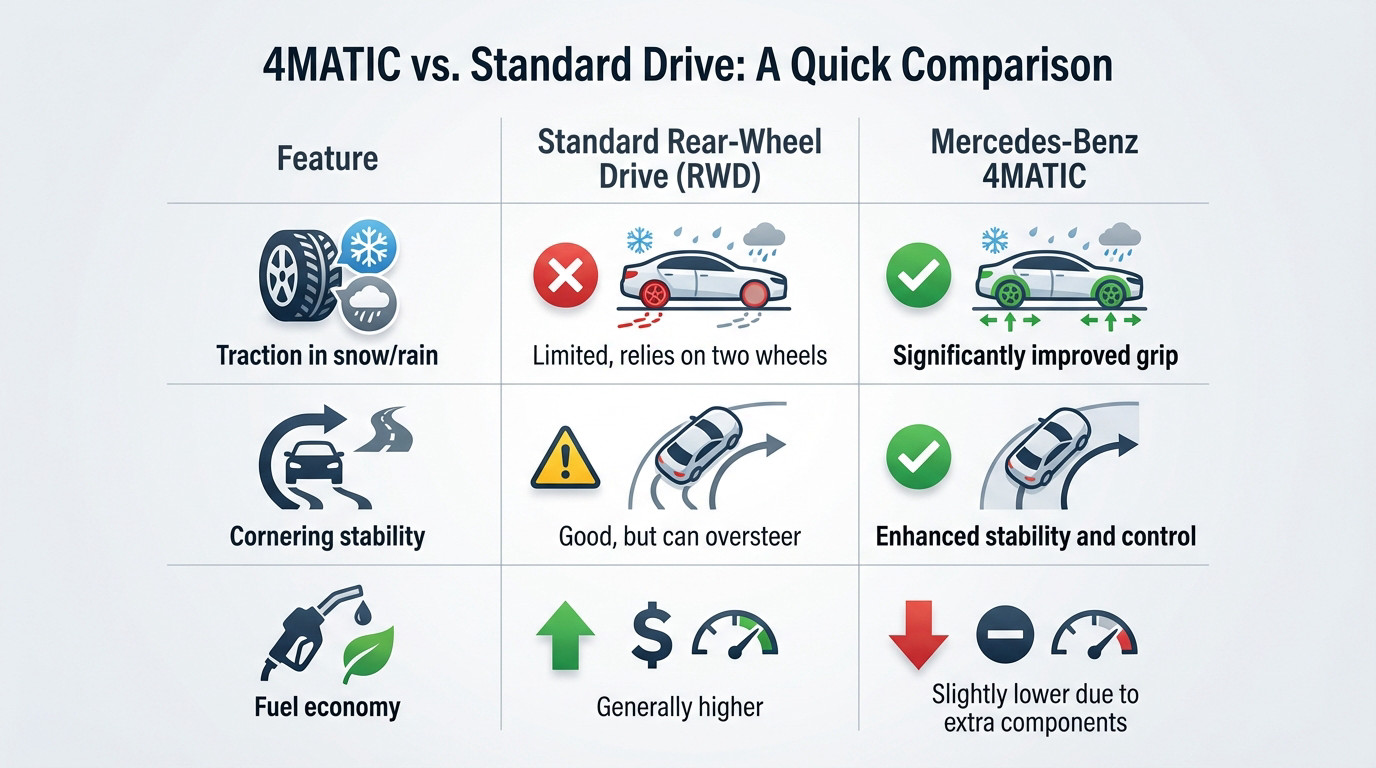
| Feature | Standard Rear-Wheel Drive (RWD) | Mercedes-Benz 4MATIC |
|---|---|---|
| Traction in snow/rain | Limited, relies on two wheels | Significantly improved grip |
| Cornering stability | Good, but can oversteer | Enhanced stability and control |
| Fuel economy | Generally higher | Slightly lower due to extra components |
The Practical Side: Cost and Availability
But beyond the impressive engineering, what does this actually imply for you, as an owner?
Are There Any Downsides to Consider?
First, you will likely see a slight dip in fuel economy compared to a rear-wheel-drive model. It makes sense when you think about it. The system adds weight and mechanical friction that a standard car simply avoids.
Then there is the added mechanical complexity. More moving parts inevitably mean a higher risk of maintenance costs down the road. But for many drivers, that is a fair price to pay for superior safety.
Which Mercedes-Benz Models Offer 4Matic?
Gone are the days when all-wheel drive was just a niche option for mountains explorers. Today, Mercedes integrates this system into nearly every corner of their lineup.
You can equip almost any chassis with this tech, from compact commuters to full-size luxury cruisers. It is incredibly ubiquitous across the brand. Here is where you will find the badge:
- Sedans and Coupes: Available across the A-Class, C-Class, E-Class, S-Class, and CLS ranges.
- SUVs: A standard or optional feature on almost the entire SUV lineup, including the GLA, GLB, GLC, GLE, and GLS.
- Performance Models: Integral to most AMG models, often in the advanced 4MATIC+ configuration.
Ultimately, 4MATIC represents more than just a badge; it is a sophisticated system designed for superior safety and performance. Whether you need stability in snow or dynamic control with 4MATIC+, the technology adapts to every drive. Despite slightly higher costs, the enhanced confidence behind the wheel makes it an invaluable addition to your Mercedes-Benz.
FAQ
What does the 4MATIC name actually stand for?
4MATIC is the marketing name Mercedes-Benz uses for its all-wheel-drive (AWD) system. The term itself is a combination of "4-wheel drive" and "automatic." Unlike a standard car that sends power to only two wheels, this system automatically distributes power to all four wheels to improve traction and handling.
Is 4MATIC better than a traditional 4WD system?
For most daily driving scenarios, yes. Traditional 4WD is often manual and designed for heavy off-roading, which can feel clunky on pavement. 4MATIC is a sophisticated AWD system designed for the road. It seamlessly adapts to changing conditions—like sudden rain or patchy ice—providing superior stability and comfort without requiring any input from the driver.
Can a 4MATIC car handle driving in snow?
Absolutely, this is one of the system's primary benefits. By driving all four wheels, 4MATIC significantly improves grip and acceleration on snow-covered roads compared to a rear-wheel-drive vehicle. While it doesn't replace the need for winter tires, it offers much greater predictability and control when the weather turns bad.
Is the 4MATIC system always active?
It depends on the specific version. Many models feature permanent AWD, where power is constantly split between the front and rear axles. However, newer "variable" 4MATIC systems can drive primarily with the front wheels to save fuel, instantly engaging the rear wheels only when the system detects a loss of traction.
Can I turn off the 4MATIC system?
On most standard Mercedes-Benz models, the system is always on and cannot be deactivated, as it is integral to the car's safety features. The exception lies with high-performance Mercedes-AMG models equipped with 4MATIC+. These often feature a ""Drift Mode" that allows you to disconnect the front axle, sending 100% of the power to the rear wheels for track use.
Are there any downsides to owning a 4MATIC vehicle?
The main trade-offs are fuel economy and complexity. Because the system adds weight and mechanical components, a 4MATIC vehicle typically consumes slightly more fuel than its two-wheel-drive counterpart. Additionally, having more moving parts can potentially lead to higher maintenance costs over the long term.
Is upgrading to 4MATIC really worth the extra cost?
If you live in a region with four distinct seasons, frequent rain, or snow, the investment is well worth it for the added safety and confidence. The system provides stability that a two-wheel-drive car simply cannot match in poor conditions. However, if you live in a dry, warm climate, you might prefer the fuel efficiency of a standard rear-wheel-drive model.